
How Much Does a Funeral Cost? Why Even Dying Has Become Unaffordable in America
How much does a funeral cost in America today? Enough that families are changing their loved ones’ final wishes — not for religious reasons, not for personal ones, but because they simply cannot pay.
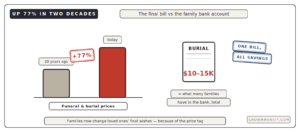
NBC News opens its investigation with Lanasia Robinson, whose mother never wanted to be cremated. Her ashes now sit in her daughter’s apartment, because the family couldn’t afford the more than $10,000 a burial would have cost. She is far from alone: funeral and burial prices have climbed roughly 77% over two decades, and a full burial service now runs $10,000 to $15,000 — about as much as many American families have in the bank, total.
The coping mechanisms tell the story of the era: funeral credit cards, rented caskets, urns ordered from Amazon. This guide breaks down what funerals actually cost and why, the economics quietly driving prices up, the consumer rights most grieving families never learn about, and what this “final bill” says about affordability in America — in plain English. (New to economics? Start with What Is an Economy?)
First: the actual price list
The National Funeral Directors Association’s medians give the honest baseline, via CNBC’s breakdown:
| Option | Median cost |
|---|---|
| Traditional funeral with viewing and burial | ~$8,300 — before the cemetery plot |
| Funeral with viewing, then cremation | ~$6,280 |
| No-frills cremation — no service, no urn | $2,500+ |
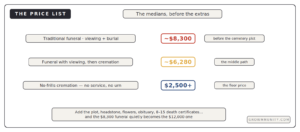
And the medians undercount reality. Add a cemetery plot (thousands more in big metros), a headstone, flowers, printed programs, an obituary notice, eight to fifteen certified death certificates, and a reception — and the “$8,300 funeral” quietly becomes the $12,000 one. That’s how the $10,000-15,000 range in NBC’s reporting arises, and why even the stripped-down option strains a typical budget.
Why prices climbed 77%: the economics behind the bill
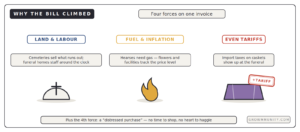
A funeral is a bundle of goods and services, and nearly every ingredient got more expensive at once.
1. It’s a labour- and land-heavy service. Funeral homes pay staff, run facilities around the clock, and cemeteries sell something that genuinely runs out: urban land. Everything we described in Why Is Housing So Expensive? about scarce land applies to graves too.
2. Fuel and inflation ride along. Hearses need gas; flowers, embalming supplies, and facilities all track the general price level — the mechanics from our inflation explainer, applied to the one purchase no one can postpone indefinitely.
3. Even tariffs show up at the funeral. NBC’s reporting notes that tariffs on imported caskets have contributed to rising prices — a striking real-world echo of our tariff explainer’s core lesson: import taxes are ultimately paid somewhere downstream, sometimes in the least expected places.
4. It’s the ultimate “distressed purchase.” Economics has a term for buying under pressure with no time to shop: grieving families comparison-shop the least of any consumers, decide within days, and often feel that spending less means loving less. Sellers know this. It’s why regulators wrote special rules for this industry — more on that below.
How families are coping: the improvised economy of grief
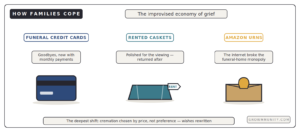
Funeral credit cards. Specialised financing now exists just to spread the cost of a goodbye into monthly payments — the clearest sign that funerals have joined houses and cars as debt-financed purchases.
Rented caskets. A polished casket for the viewing, rented; a simple container for what follows. Practical, increasingly common, and unthinkable a generation ago.
Amazon urns and online caskets. The internet has broken the funeral home’s retail monopoly — a Batesville-style casket that lists for thousands at the funeral home can cost a fraction online.
Cremation as a budget decision. The deepest shift: cremation keeps gaining not by preference but by price. When a family overrides a mother’s stated wishes because of a $10,000 gap, that is affordability rewriting culture in real time.
The consumer rights nobody tells grieving families
Here is the most practically useful part of this article. The US Federal Trade Commission’s “Funeral Rule” exists precisely because grieving buyers are vulnerable. Among its protections: funeral homes must give itemised price lists (including over the phone), you may buy only the services you want rather than mandatory packages, and — the one almost nobody knows — funeral homes must accept a casket or urn you bought elsewhere, without charging a handling fee. The online casket is not just cheaper; refusing it is against the rules.
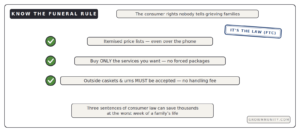
Knowing three sentences of consumer law can save a family thousands of dollars at the worst week of their lives. That is as close to free money as economics offers.
Why this is bigger than funerals
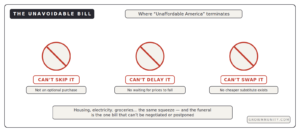
NBC frames its story as part of a series on “Unaffordable America,” and the framing is right. We’ve now traced the same squeeze through housing, electricity, and groceries — and the funeral is where it all terminates: a bill that cannot be skipped, delayed until prices fall, or substituted away. When the unavoidable purchases outrun savings, families don’t stop buying; they borrow, improvise, and compromise on things they hold sacred. The final bill has become a stress test of the household balance sheet — and by NBC’s account, more and more households are failing it.
Two honest views: crisis or adaptation?
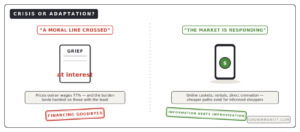
The crisis view: a society where a dignified goodbye costs more than a typical family’s savings — and where grief is financed at interest — has an affordability problem that has crossed a moral line. The 77% climb far outpaced wages, the industry profits from distressed buyers, and the burden lands hardest on lower-income families, compounding at the worst possible moment.
The adaptation view: painful as it is, the market is responding: online caskets broke a retail monopoly, rentals and direct cremation created genuinely cheaper paths, and transparency rules give shoppers real power if they use it. Cremation’s rise mirrors most wealthy countries, and much of the “cost of dying” is a choice set that families can — with information and planning — navigate for far less.
Both views agree on one thing: information beats improvisation. The families who fare worst are those who learn the prices, the rules, and the alternatives during the worst week of their lives instead of before it.
Difficult words, made simple
| Term | Plain-English meaning |
|---|---|
| Median funeral cost | The middle price — ~$8,300 for burial with viewing, before the plot |
| Direct cremation | Cremation with no service or urn — the floor price, now $2,500+ |
| Distressed purchase | Buying under time pressure and emotion — the weakest bargaining position there is |
| The Funeral Rule | FTC rules: itemised prices, no forced packages, outside caskets must be accepted |
| Funeral financing | Credit cards and loans built for goodbyes — grief, now with monthly payments |
| Rental casket | A display casket for the viewing only — dignity decoupled from ownership |
| Pre-need planning | Arranging and pricing a funeral in advance — shopping while calm, not grieving |
| Cemetery plot | The land itself — the scarcest, fastest-inflating line on the bill |
| Death certificates | Families typically need 8-15 certified copies at $10-25 each |
| Unaffordable America | NBC’s series name — and the pattern this story completes |
The big takeaway
The cost of dying is the cost of living’s final chapter. The same forces we’ve tracked all year — inflation, scarce land, fuel, even tariffs — converge on a purchase no one can refuse, at a moment no one can negotiate. The result: prices up 77% in two decades, families financing grief on credit, and final wishes rewritten by price tags.
Three things worth keeping. First, know the medians — $8,300 burial, $6,280 cremation-with-viewing, $2,500 floor — so a quote can be judged, not just accepted. Second, know the Funeral Rule — itemised prices, no forced bundles, outside caskets welcome by law. Third, the cheapest funeral is the one priced in advance — because the most expensive customer in any market is the one who has to buy this week.
New to economics? Start with What Is an Economy? — then read Inflation Explained and Why Is Housing So Expensive? for the forces that ended up at the funeral home.
Sources
This article synthesizes reporting from NBC News, CNBC Select, and Newser:
• NBC News: Even death is unaffordable in America now
• CNBC Select: How Much Does a Funeral Really Cost in 2026?
• Newser: Funeral Costs Are Soaring
All figures are drawn from those reports and the sources cited within them, including the National Funeral Directors Association and the Federal Trade Commission’s Funeral Rule. This article provides consumer information, not financial, legal, or funeral-planning advice.
Growmmunity publishes explanations, not financial advice.