
Inflation: Why Your Money Buys Less Than It Used To
Inflation explained in one sentence: the same money buys less than it did before. That loaf of bread, that gallon of fuel, that monthly rent — if they all cost more today than they did a few years ago and your income has not risen to match, inflation is the reason.
It is a word that shows up in every economic headline, every political debate, and every conversation about the cost of living. Yet most people have never had it explained clearly from the beginning. We tackle the force that quietly eats into every dollar in your pocket.
What inflation actually is
Inflation is a general rise in prices across the economy over time. Not one product getting more expensive — that happens all the time for individual reasons. Inflation is when the overall level of prices climbs, so the purchasing power of each unit of money falls.
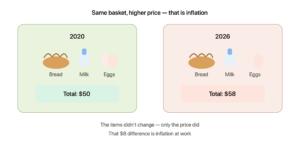
Here is the simplest way to feel it. Imagine a weekly grocery basket that cost $50 in 2020. By 2026, that exact same basket — the same bread, milk, eggs, and vegetables — costs about $58. The items did not change. The quantities did not change. Only the price changed. That difference is inflation at work.
The US measures inflation mainly through the Consumer Price Index (CPI), which tracks the average price of a fixed basket of goods and services that a typical household buys. When the news says “inflation is 3.2%,” it means the CPI basket costs 3.2% more than it did a year ago.
How bad did it get recently?
To understand why inflation dominates the headlines, look at what happened in the United States over the past few years.
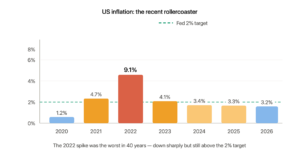
In 2020, inflation was just 1.2% — unusually low, because the pandemic froze much of the economy. Then the recovery kicked in, government stimulus cheques flooded households with cash, and supply chains around the world broke down.
By mid-2022, US inflation hit 9.1% — the worst spike in over 40 years. Grocery bills, rent, petrol, and utility costs all surged at once. For millions of households, incomes simply could not keep up.
Since then, inflation has gradually come down. By 2026 it sits at about 3.2% — much better than the peak, but still above the Federal Reserve’s 2% target. Prices are still rising, just more slowly.
What causes inflation? Two engines
Inflation can be triggered from two directions, and understanding both will help you read economic news much more clearly.
Demand-pull: “too many buyers”
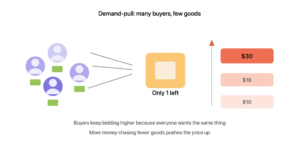
This happens when there is more money chasing the same amount of goods. When governments sent stimulus cheques during the pandemic, households suddenly had more cash. But factories were closed and shipping was disrupted, so the supply of goods could not keep up. More dollars competing for fewer products pushed prices up.
Think of it like a concert with 10,000 fans and only 5,000 tickets. People bid higher and higher because demand exceeds supply.
Cost-push: “making it costs more”
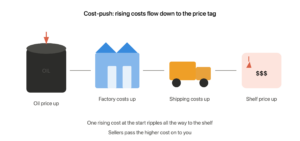
This happens when the cost of producing goods rises, and businesses pass that cost along to customers. When oil prices spike, everything that uses fuel — shipping, manufacturing, farming, heating — becomes more expensive. Those costs ripple through the economy and land on the price tags you see at the store.
The 2022 inflation spike was driven by both engines simultaneously: pandemic stimulus created demand-pull, while broken supply chains and rising energy costs created cost-push. That combination is why it hit so hard.
Who wins and who loses
Inflation is not neutral. It quietly redistributes wealth — helping some and hurting others — without anyone voting on it.
| Tends to help | Tends to hurt |
|---|---|
| Borrowers — you borrowed $200,000 for a house. With inflation, that debt becomes easier to repay because future dollars are worth less than the dollars you borrowed | Savers — money sitting in a bank account earning 1% interest while inflation runs at 3% is actually losing purchasing power every year |
| Property owners — real estate prices tend to rise with or above inflation, protecting their value | Workers whose wages lag — if your salary rises 2% but prices rise 5%, you are effectively taking a 3% pay cut |
| Governments — tax revenue grows with nominal income and sales, making debts easier to service | Retirees on fixed incomes — a pension that pays a set amount each month buys less as prices rise |
This is why inflation is sometimes called a “hidden tax.” It does not appear on a bill. It does not require legislation. But it transfers purchasing power from savers and workers to borrowers and asset owners, quietly and continuously.
Why the Federal Reserve wants 2% — not zero
This surprises many people: the Federal Reserve — America’s central bank — does not aim for zero inflation. Its official target is 2% per year.
Why would any institution deliberately want prices to rise? Because the alternative is worse.
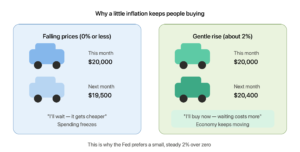
Zero inflation risks deflation — falling prices. Deflation sounds nice at first, but it is economically dangerous. If people expect prices to keep falling, they delay purchases: why buy a car today if it will be cheaper next month? That delay reduces spending, which reduces business revenue, which leads to layoffs, which reduces spending further. It is the downward spiral, triggered by falling prices. Japan experienced this stagnation for decades.
A gentle 2% rise encourages people to spend and invest now rather than later, keeps the circular flow moving, and gives the Fed room to cut interest rates during a downturn. It is deliberately chosen as a “Goldilocks” rate — not too hot, not too cold.
Jerome Powell, the current Fed Chair, has repeated many times that bringing inflation back to 2% is the central bank’s primary mission — because stable prices are the foundation on which everything else in the economy is built.
How the Fed fights inflation
The Fed’s main tool is interest rates. When inflation runs too high, the Fed raises rates. Higher rates make borrowing more expensive — mortgages, car loans, business loans all cost more. That reduces spending, which cools demand, which slows price increases.
It works, but it is painful. Higher rates also slow hiring, reduce investment, and can tip the economy toward recession. This is the central tension of monetary policy: fighting inflation without causing a downturn.
The difficulty is timing. Raise rates too little or too late, and inflation becomes entrenched. Raise them too much or too fast, and you trigger the very recession you were trying to avoid.
Why inflation matters to you — wherever you live
Even if you live outside the United States, US inflation shapes your world. When the Fed raises rates to fight inflation, the dollar strengthens. A stronger dollar makes imports cheaper for Americans but more expensive for everyone else. It also pulls investment money out of other countries and into the US, which can weaken currencies and raise borrowing costs far from American shores.
On a personal level, understanding inflation changes three things:
How you save. Money in a zero-interest account is losing real value every year inflation exceeds your interest rate. Understanding this is the first step toward protecting your purchasing power.
How you earn. If your salary has not risen at least as fast as inflation, your real income has fallen. Knowing the inflation rate gives you concrete ground to stand on when negotiating a raise.
How you read the news. When a headline says “the economy grew 4%,” the next question is: what was inflation? If inflation was 3%, real growth was only 1%. Without adjusting for inflation, economic numbers are misleading.
Difficult words, made simple
| Term | Plain-English meaning |
|---|---|
| Inflation | A general rise in prices that reduces how much each unit of money can buy |
| CPI (Consumer Price Index) | A measure of how much a standard basket of goods costs compared to last year |
| Demand-pull inflation | Prices rise because too many buyers chase too few goods |
| Cost-push inflation | Prices rise because it costs more to produce goods |
| Purchasing power | How much real stuff your money can buy |
| Deflation | Falling prices — sounds good but freezes economic activity |
| The Fed (Federal Reserve) | America’s central bank, which sets interest rates and manages the money supply |
The big takeaway
Inflation is not a mysterious force. It is what happens when the amount of money in an economy grows faster than the amount of goods that economy produces. It quietly moves wealth from savers to borrowers, from wage earners to asset owners, from the prepared to the unprepared.
The Fed aims for 2% because a small, steady rise keeps the economy moving without destroying trust in the currency — tthe very trust that underpins money itself. When inflation breaks above that target, as it did spectacularly in 2022, the Fed fights back with interest rates.
Tomorrow, we look at inflation’s opposite twin — deflation — and why falling prices, which sound like a gift, can be even more dangerous.
Sources
Inflation data cited in this article comes from the US Bureau of Labor Statistics CPI reports. This article is general educational information, not financial advice.
Previous: What Is Money, Really? Next: Deflation and Why It Is Also Dangerous.
Growmmunity publishes explanations, not financial advice.
3 thoughts on “Inflation: Why Your Money Buys Less Than It Used To”