
The Stock Market Explained: What It Really Is and How It Works
The stock market is talked about constantly — on the news, in conversations, in every discussion about the economy — yet a surprising number of people have only the vaguest idea of what it actually is. They picture a chaotic room of shouting traders, or a mysterious casino where fortunes are won and lost. The reality is far simpler, and far more interesting.
At its core, the stock market is just a place where people buy and sell small pieces of companies. That is the whole idea. Today we will build up from that simple foundation, using clear examples, to explain what stocks are, how the market works, why prices move, and what the whole thing has to do with the wider economy.
What a stock actually is
A stock is a small piece of ownership in a company. When you buy a share of a company, you literally own a tiny slice of it — its buildings, its brand, its future profits, all of it, in miniature.

Imagine a pizza restaurant worth $1 million. If the owner divides the business into a million equal slices and you buy one, you own one-millionth of that restaurant. If you buy 10,000 slices, you own 1% of the whole thing. Those slices are called shares, or stocks, and owning them makes you a part-owner — a shareholder — of the business.
This is the key difference from a bond, which we covered in Bonds Explained. A bond makes you a lender who is owed money. A stock makes you an owner who shares in the company’s success or failure. That distinction shapes everything about how stocks behave.
Why companies sell stock
Why would a company give away pieces of itself? The answer is simple: to raise money.
Suppose our pizza restaurant wants to open twenty new locations but does not have the cash. It has two main options. It could borrow the money by issuing bonds, which must be repaid with interest. Or it could sell ownership slices — shares — to investors, raising money it never has to pay back.
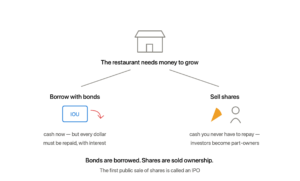
In exchange for their money, those investors become part-owners. They hope the company will grow, making their slices more valuable, and they may receive a share of the profits. When a company sells shares to the public for the first time, it is called an initial public offering, or IPO. From that point on, those shares can be bought and sold by anyone — and that buying and selling is the stock market.
What the stock market really is
The stock market is simply a giant, organized marketplace where these ownership slices are bought and sold. It is not owned by any one company; it is a system that connects millions of buyers and sellers.
In the past, this happened in physical buildings with traders shouting orders across a floor — the chaotic image many people still picture. Today, it happens almost entirely through computers, with buyers and sellers matched electronically in fractions of a second. The famous stock exchanges, like the New York Stock Exchange or Nasdaq, are the organized venues where all this trading takes place.

When you hear that someone “bought Apple stock,” it means they used the stock market to purchase a small ownership slice of Apple from someone else who was selling. No pizzas, no shouting — just ownership changing hands.
Why stock prices move
Stock prices change every second the market is open, and the reason comes straight back to a principle we already know: supply and demand, from Supply and Demand.
A stock’s price is simply what buyers and sellers currently agree it is worth. If more people want to buy a stock than sell it, the price rises. If more want to sell than buy, it falls. Every price you see is the meeting point of these two forces at that instant.
But what makes people want to buy or sell? Underneath it all, one thing dominates: expectations about the company’s future. If people believe a company will earn much more in the future — because it launched a hit product, entered a huge new market, or beat expectations — they rush to buy, and the price climbs. If they fear the company will struggle, they sell, and the price drops.
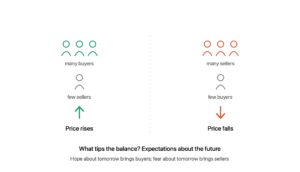
This is why stock prices often move on news rather than on present facts. A stock can rise on the mere hope of future profits, or fall on the fear of future trouble, long before any of it actually happens. The stock market is, in large part, a giant machine for pricing the future.
How investors make money from stocks
There are two ways owning a stock can reward you, and understanding both clarifies why people invest.
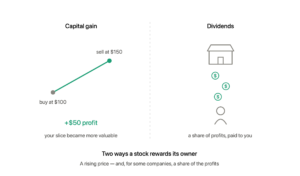
The price going up. If you buy a share for $100 and it later rises to $150, you can sell it for a $50 profit. This gain is called a capital gain, and it is the reason most people buy stocks — the hope that the slice they own becomes more valuable over time.
Dividends. Some companies share a portion of their profits directly with shareholders through regular payments called dividends. If you own shares in such a company, you receive a small cash payment periodically, simply for being an owner. Not all companies pay dividends — many growing companies reinvest all their profits instead — but for those that do, it is a second stream of reward.
The risk that comes with the reward
Stocks can be rewarding, but they carry real risk, and being honest about this is essential.
Because a stock makes you an owner, you share in the company’s losses as well as its gains. If the company struggles, your shares can fall in value — sometimes sharply. If the company fails entirely, your shares can become worthless, and as an owner, you are paid last, after lenders and bondholders. There is no guarantee you get your money back.
Stock prices can also swing wildly in the short term, driven by emotion, news, and shifting expectations. A stock that seems stable can drop 10% in a day on bad news. This is why stocks are generally considered riskier than bonds, and why the potential for higher reward comes hand in hand with the potential for greater loss. It is the fundamental trade-off of investing, one we will explore more fully when we look at risk and return.
Difficult words, made simple
| Term | Plain-English meaning |
|---|---|
| Stock (share) | A small piece of ownership in a company |
| Shareholder | Someone who owns shares and therefore part of a company |
| Stock market | The marketplace where shares are bought and sold |
| IPO | When a company first sells its shares to the public |
| Capital gain | Profit made when a stock’s price rises above what you paid |
| Dividend | A share of company profits paid to shareholders |
| Stock exchange | An organized venue like the NYSE or Nasdaq where trading happens |
The big takeaway
The stock market is simply a marketplace for buying and selling small slices of ownership in companies. When you own a stock, you own a piece of a real business, sharing in its success through a rising price or dividends, and in its failure through falling value. Prices move constantly on supply and demand, driven above all by expectations about each company’s future.
Stripped of its intimidating reputation, the stock market is one of the most understandable ideas in finance: it is ownership, traded. It offers the chance of real reward, carries the weight of real risk, and serves as one of the great engines that channels money from savers into the companies that build the economy. Understanding it is the first step toward seeing the market not as a casino, but as what it truly is — the marketplace of ownership itself.
Sources
This article explains standard principles of how the stock market works. It is general educational information, not financial advice.
Related reading: Bonds Explained and Supply and Demand.
Growmmunity publishes explanations, not financial advice.