
Building Your Own Economic Worldview: How It All Fits Together
Building your own economic worldview is the destination this entire journey has been leading toward. Over this series, we started from the simplest questions — what is money, what is inflation — and gradually built up to the great forces that move the whole world: central banks, markets, trade, currencies, oil, and the fast-growing economies rising around the globe. Now it is time to step back and see the whole picture, to understand how every piece we have explored fits together into a single, connected system. This is where scattered facts become real understanding.
Think of everything we have built as a house. The foundation is money and prices. The main pillar holding it up is interest rates. The rooms inside are markets, trade, and investing. And the roof over it all is the global economy. Today we walk through the finished house, room by room, and see how every part supports every other.
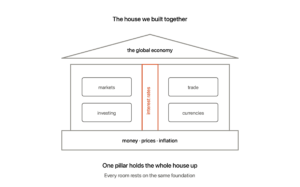
It all starts with money and prices
At the foundation of everything lies money itself. We began by understanding what money really is and why it has value, then explored how its value changes through inflation — the gradual erosion of what your money can buy. From there we learned about supply and demand, the fundamental force that sets prices throughout the economy.
These first ideas are the bedrock. Money is the medium through which all economic activity flows, prices are the signals that guide it, and inflation is the constant force reshaping the value of everything. Every later idea builds on this base. If you understand money, prices, and inflation, you hold the vocabulary of the entire economy — and just like learning words before sentences, everything that follows becomes readable.
The most powerful force: interest rates and central banks
From that foundation, we discovered what may be the single most powerful force in the modern economy: interest rates, and the central banks that set them. We learned what interest rates are, how the Federal Reserve sets them, and why a decision made in one building in Washington ripples across the entire planet. We also saw how central banks around the world manage their own economies the same way.
This was a turning point in the series. Once you understand that interest rates are the price of money, and that central banks move this price to balance inflation against recession, an enormous amount of the economy comes into focus. Rates influence borrowing, saving, spending, markets, currencies, and the fortunes of nations. The central bank, pulling this one great lever, sits near the center of the whole system.
How money grows: markets and investing
We then turned to how money grows over time, exploring bonds, the stock market, indexes, and index funds. We learned why stock prices move, the power of compound interest, and the fundamental relationship between risk and return that governs all investing.
Here the deep logic of finance revealed itself. Higher returns demand higher risk. Time and compounding are extraordinarily powerful. Markets react not just to events but to expectations. These are not just rules for investors — they are windows into how the financial world thinks, and how the value of everything from a company to a currency is constantly being weighed and re-weighed by millions of participants.
When things go wrong: bubbles, crashes, and downturns
No honest picture of the economy is complete without its darker chapters. We studied bubbles and crashes, and the recessions and depressions that follow when the economy contracts. We saw how booms can inflate beyond reason and then collapse, and how downturns spiral through the whole system, driven by rising unemployment.
These lessons bring balance and realism. The economy does not move in a straight line; it breathes, like lungs, in cycles of expansion and contraction, of confidence and fear. Understanding this rhythm — and the forces that drive it — protects you from being swept up in the euphoria of booms or the panic of busts, and lets you see the longer pattern beneath the noise.
The global picture: trade, currencies, and the wider world
Finally, we widened the lens to the whole world. We explored exchange rates and why the dollar dominates, international trade and tariffs, supply chains, emerging markets, and the role of oil. We saw how nations are bound together in a vast web of exchange, and how an event in one place ripples across the globe.
This is where the true scale of the economy became visible. No country stands alone. Money, goods, and shocks flow constantly across borders. The strength of the dollar shapes the fate of distant economies; a disruption to one shipping route raises prices worldwide; the decisions of the Fed reach into every corner of the planet. The economy, ultimately, is a single interconnected global system, and you can now see its outlines whole.
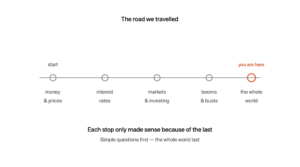
The great themes that tie it all together
Step back from the individual topics, and a few profound themes run through everything we have learned. These are the deep truths of economics, and holding onto them is more valuable than memorizing any single fact.
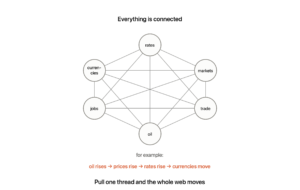
Everything is connected. The single most important lesson of all. Think of an orchestra: no instrument plays alone, and every part shapes the sound of the whole. Interest rates touch markets; trade touches currencies; oil touches inflation; the Fed touches the world. Nothing stands in isolation. Real understanding comes from tracing the links.
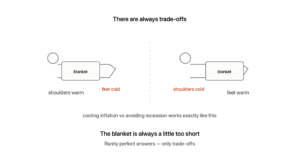
There are always trade-offs. Efficiency versus resilience, risk versus return, growth versus stability, cooling inflation versus avoiding recession. Like a blanket that is slightly too short, pulling it up to cover your shoulders uncovers your feet. The economy is a constant balancing act, rarely offering perfect answers, only trade-offs between competing goods.
Expectations matter as much as reality. Markets move on surprises, not just events, as we saw in How to Read Economic News. What people believe will happen shapes what does happen. The future, anticipated, reaches back to shape the present.
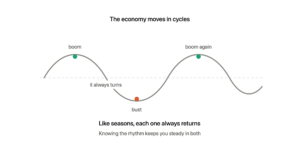
The economy moves in cycles. Booms and busts, expansions and recessions, like seasons that always return. Understanding this rhythm keeps you steady when others are swept up in fear or greed.
Your framework for life
What you now hold is not a collection of facts to be forgotten, but a framework for understanding the economic world for the rest of your life. Facts fade; frameworks endure. The specific numbers in the news will change, but the way the pieces fit together — the logic connecting money, rates, markets, trade, and the world — remains.
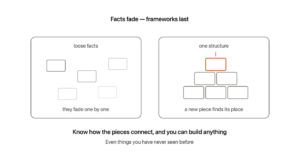
Think of it like a box of building blocks. You will forget which exact pieces you used today, but once you know how the pieces connect, you can build anything — including things you have never seen before. With this framework, you can make sense of events that have not even happened yet. A future crisis, a new policy, an unexpected shock — each will find its place in the web you now understand. You are equipped not just for today’s economy but for a lifetime of watching it evolve.
Why this matters to you
Understanding the economy is one of the most practical and empowering forms of knowledge there is. It touches everything — your job, your savings, your cost of living, your future, and the world your choices unfold within. To understand it is to move through life with clearer eyes and greater confidence.
This knowledge also makes you a more capable citizen and decision-maker. You can evaluate the policies leaders propose, understand the forces shaping your society, and make more informed choices about your own money and life. In a world profoundly shaped by economic forces, economic understanding is a form of freedom.
Most of all, you have transformed the economy from something intimidating and impenetrable into something you can understand. The swirling complexity of headlines, markets, and global events is no longer noise but a system you can read. And like riding a bicycle, this is not the kind of knowledge you lose. You began this journey perhaps feeling that economics was beyond you. You end it holding a genuine, connected understanding of the forces that move the world — and that understanding, once gained, is yours to keep and to build upon for the rest of your life. That is the real destination, and you have reached it.
Difficult words, made simple
| Term | Plain-English meaning |
|---|---|
| Economic worldview | Your overall mental model of how the economy works |
| Framework | A structure for organizing knowledge that outlasts single facts |
| Synthesis | Combining many ideas into one connected understanding |
| Trade-off | Gaining one good thing at the cost of another |
| Economic cycle | The repeating rhythm of expansion and contraction |
| Interconnected | All parts linked so each affects the others |
| Economic literacy | The ability to understand and use economic ideas |
The big takeaway
Building your own economic worldview means seeing how every piece fits together into one connected system. It starts with money, prices, and inflation, builds up through the great power of interest rates and central banks, extends into markets and investing, confronts the cycles of booms and busts, and widens out to the global web of trade, currencies, and oil. Beneath it all run a few profound themes: everything is connected, there are always trade-offs, expectations matter as much as reality, and the economy moves in cycles.
What you hold now is not a pile of facts but a framework for life — a way to understand economic events that have not even happened yet. You have transformed the economy from something intimidating into something you can read, and gained a form of knowledge that touches your job, your money, your future, and your place in the world. That understanding is yours to keep, and to build upon, for the rest of your life.
Explore the full series
This article completes our journey through the foundations of the economy. To revisit any topic, explore the earlier articles below.
Money and prices: Inflation Explained · Deflation · Supply and Demand · GDP Explained
Interest rates and central banks: Why Fed Decisions Move the Whole World · Central Banks Around the World
Markets and investing: Bonds · Why Stock Prices Move · Index Funds · Compound Interest · Risk and Return
Cycles and crises: Bubbles and Crashes · Recessions and Depressions · Unemployment Explained
The global economy: Exchange Rates · Dollar Dominance · International Trade · Tariffs · Supply Chains · Emerging Markets · Oil and the Economy
Putting it together: How to Read Economic News
Sources
This article synthesizes the standard principles of economics covered throughout this educational series. It is general educational information, not financial advice.
Growmmunity publishes explanations, not financial advice.