
What Is a Stablecoin? The Digital Dollar Quietly Rewiring How Money Moves
Here’s a statistic that surprises almost everyone: hundreds of millions of people already have stablecoins within reach of their thumb — through apps they use every day, like PayPal, Venmo, Zelle, and Cash App — and most couldn’t tell you what a stablecoin is.
Meanwhile, the numbers behind the scenes are moving fast. Industry forecasts now suggest the total supply of stablecoins could exceed $3 trillion by 2028 — two years earlier than originally predicted. America’s biggest banks, including JPMorgan and Bank of America, are moving toward issuing their own. And in the year since the US passed its first federal stablecoin law, the announcements have been, in one banking publication’s words, relentless.
So what exactly is this thing that’s spreading through your payment apps, worrying your bank, and — in the strangest twist of all — quietly becoming a new buyer of America’s $40 trillion debt? This guide explains it all in plain English. (New to economics? Start with our foundation guide, What Is an Economy?)
First: what is a stablecoin?
A stablecoin is a digital token designed to always be worth exactly one unit of a real currency — almost always one US dollar. One coin, one dollar. Today, tomorrow, always. That’s the “stable” part.
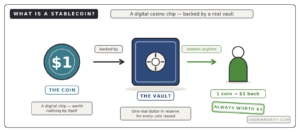
The easiest way to picture it is a casino chip. When you buy a $100 chip, the casino puts your $100 in the vault. The chip is easier to slide across a table than cash — but its value comes entirely from the promise that you can walk back to the cashier anytime and swap it for the real $100. A stablecoin works the same way: a digital chip, backed by real dollars sitting in a vault, redeemable one-for-one.
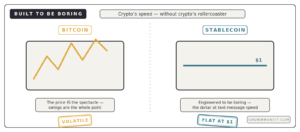
This makes stablecoins the opposite of what most people think of as “crypto.” Bitcoin’s price swings wildly — that’s the whole spectacle. A stablecoin is engineered to be boring: it borrows crypto’s technology (moving value online instantly, 24/7, across borders, without a bank in the middle) while ditching crypto’s volatility. Think of it as the dollar, but with the speed of a text message.
How does it stay worth exactly $1? (The part that matters most)

The peg isn’t magic — it’s a vault. For every coin issued, the issuer is supposed to hold one dollar of safe assets in reserve: actual cash and, mostly, short-term US government debt (Treasury bills). If you ever want out, you redeem your coin and the issuer pays you a real dollar from the vault.
If you read our gold explainer, you’ll recognise the deeper pattern here. We described gold as the one asset that makes no promises — which means no promise can break. A stablecoin is the exact opposite: it is a pure promise. The token itself is worth nothing; its entire value is the claim that a real dollar stands behind it. That’s not a flaw — it’s the design. But it means everything depends on two questions: are the reserves really there, and can you really get them back? Hold that thought — it’s where both the new laws and the biggest risks come from.
The background: why 2025-26 changed everything

Stablecoins have existed for a decade, but they lived in a legal grey zone: useful, growing, and officially unblessed. Two questions kept serious institutions away — does the technology work, and will regulators allow it? As one industry analysis put it this month, both questions are now effectively settled. Three things did it.
1. America passed its first stablecoin law. The GENIUS Act, signed in July 2025, created the first federal rulebook for payment stablecoins. In plain English, it answers the vault questions: who may issue coins (banks and specially licensed non-bank issuers, overseen by a federal banking regulator), what must sit in the vault, and — crucially — it declares compliant stablecoins to be neither securities nor commodities, ending years of legal limbo. Regulators are still finalising the detailed rules through 2026, but the foundation now exists.
2. Europe and Asia built rulebooks too. The EU’s MiCA framework — the world’s first unified crypto rulebook — became fully mandatory in mid-2026, with strict requirements that coins be redeemable at full face value. Japan saw its first yen-pegged stablecoin launch, and frameworks firmed up from Hong Kong to the UAE. Regulation stopped being the obstacle and became the on-ramp.
3. The last big ambiguity fell. In March 2026, US market regulators jointly classified major crypto assets as digital commodities — removing, in one analyst’s words, one of the biggest sources of uncertainty for institutions.
The pattern is worth noticing because it defies intuition: the common assumption was that regulation would slow this technology down. The opposite happened. Clear rules are precisely what let cautious giants — banks, corporate treasurers, payment networks — finally walk in.
Why your bank is suddenly nervous
Here’s where the story gets competitive — and why “stablecoin strategy” became, per one banking journal, a 2026 question for banks, not a 2027 one.
Stablecoins don’t need banks to reach customers. They run on their own rails, outside the traditional payment system. And the customers are already leaving through the side door: one analysis of community bank data found that 90% of institutions have customers actively transacting with Coinbase, with meaningful money flowing out. Meanwhile, a survey found 77% of people would open a crypto or stablecoin wallet inside their banking app — if their bank offered one.

Read those two numbers together and you see the squeeze: the demand exists, and if banks don’t serve it, someone else will — using the deposits that used to sit quietly in checking accounts. That’s why the response has been so fast. Money-center giants are moving toward issuing their own coins; regional banks that once kept blockchain projects on the shelf are investing in real-time settlement and custody; and everyone faces the same three-way choice the industry now recites like a mantra: build your own, partner with an issuer, or integrate an existing coin.
A useful analogy: this is the moment record labels faced when streaming arrived. The new rails work with or without you — the only question is whether you’re on them.
The twist nobody saw coming: stablecoins are buying America’s debt
Now for the part that connects this story to everything else we’ve covered — and it’s genuinely surprising.
Remember what sits in the vault behind each coin: mostly short-term US Treasury bills. So every time the stablecoin market grows by a billion dollars, roughly a billion dollars of new demand shows up for US government debt. Industry analysis explicitly notes that the new rules are shaping demand for US debt. If supply really does reach $3 trillion, stablecoin issuers collectively become one of the largest holders of Treasuries on earth — a brand-new class of lender to Washington, born from payment apps.
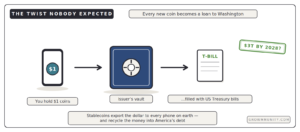
Connect the threads: America carries a $40 trillion debt that needs ever more buyers, and the dollar’s global dominance rests on the world wanting dollar assets. Stablecoins quietly reinforce both: they package the dollar into a form anyone on earth with a phone can hold, and they recycle the proceeds straight into Treasury bills. This is why Washington moved to regulate rather than ban them — a well-behaved stablecoin industry effectively exports the dollar and funds the government at the same time.
Two honest views: upgrade or accident waiting?
As always, both serious positions, fairly stated.

The “upgrade” view: this is simply money catching up with the internet. Payments that settle in seconds, around the clock, across borders, for pennies — with regulation now requiring full reserves and guaranteed redemption. Adoption forecasts keep being revised up, the biggest banks are joining rather than fighting, and clear rules have channelled the technology toward its safest form: boring, fully backed digital dollars.
The cautious view: a stablecoin is a promise, and promises can break. These are not bank deposits — there is no deposit insurance standing behind them. If holders ever doubt the vault — the reserves’ quality, the issuer’s honesty, the speed of redemption — the result looks like a digital-age bank run, at internet speed. History has examples of pegs that broke. Regulation reduces this risk; it cannot abolish it. And moving trillions of payment flows onto new rails, however promising, concentrates new kinds of operational risk the system hasn’t stress-tested at scale.
Both sides agree on what actually matters: the quality of the vault. Full, verifiable, boring reserves make the optimists right; anything cleverer than that makes the pessimists right. Which is why every serious rulebook — GENIUS, MiCA, and the rest — obsesses over the same two words: reserves and redemption.
Difficult words, made simple
| Term | Plain-English meaning |
|---|---|
| Stablecoin | A digital token designed to always equal $1 — a casino chip backed by a vault |
| The peg | The 1-coin-equals-1-dollar promise the whole system rests on |
| Reserves | The real assets in the vault — cash and short-term US Treasury bills |
| Redemption | Your right to swap the coin back for a real dollar — the promise being kept |
| GENIUS Act | America’s first federal stablecoin law (July 2025): who may issue, what backs the coins |
| MiCA | The EU’s unified crypto rulebook — fully mandatory since mid-2026 |
| De-peg | When a coin trades below $1 — the promise wobbling; the nightmare scenario is a run |
| Issuer | The company (increasingly, the bank) that creates coins and manages the vault |
| Settlement | The moment money actually changes hands — stablecoins do it in seconds, 24/7 |
| Build / partner / integrate | The three doors every bank now faces: issue your own coin, team up with an issuer, or plug in an existing one |
The big takeaway
Strip away the crypto vocabulary and a stablecoin is an old idea in new clothes: a fully backed IOU — the casino chip, the cashier’s check — rebuilt for the internet. What changed in 2025-26 wasn’t the technology; it was the trust infrastructure. Laws on three continents answered the vault questions, and the moment they did, the cautious money walked in.
For a beginner, three ideas are worth keeping. First, stability is manufactured, not natural — the peg holds only as long as the reserves and redemption do. Second, regulation accelerated this market rather than smothering it — clarity, it turns out, was the missing ingredient. Third, and most striking: this “crypto” story is really a dollar story — stablecoins spread the dollar to every phone on earth and recycle the money into US debt, which is exactly why Washington chose to license them rather than fight them.
Three things worth watching from here: the final GENIUS Act rules (due through 2026 — the fine print on vaults); which major bank launches a coin first (formal applications are expected later this year); and total stablecoin supply on its march toward $3 trillion — because that number is simultaneously a payments revolution and a rising bid for America’s debt.
New to economics? Start with What Is an Economy? and What Is Money? — then read Dollar Dominance and America’s $40 Trillion Debt to see the bigger machine stablecoins just plugged into.
Sources
This article synthesizes reporting and analysis from Banking Exchange, The Payments Association, and DailyCoin:
• Banking Exchange: “Stablecoin Strategy” Is a 2026 Question for Banks, Not a 2027 One
• The Payments Association: How stablecoin regulation is reshaping payments in 2026
• DailyCoin: How Stablecoin Regulation Drives Blockchain Innovation in 2026
All figures and quotes are drawn from those reports and the sources cited within them, including Chainalysis, KlariVis, and YouGov survey data. Background on the law: GENIUS Act and MiCA. This article explains the technology and the debate around it without endorsing any product — stablecoins are not bank deposits and are not covered by deposit insurance. This is general information, not financial advice.
Growmmunity publishes explanations, not financial advice.