
Youth Unemployment Hits 67 Million: Why Can’t Young People Find Jobs — and Is AI Making It Worse?
Why can’t young people find jobs? The United Nations’ labour agency just published a report answering exactly that question — with a title that sounds like a movie and reads like a warning: “Global Employment Trends for Youth 2026: Back to the Future.” The “back” part is the problem — because for young people trying to start their working lives, the world is moving backwards.
The headline numbers: 67 million people aged 15 to 24 are unemployed worldwide — a rate of 12.4%, rising when it should be falling. Another 257 million young people — one in five on the planet — are not in employment, education, or training at all. And in a twist that should get everyone’s attention, some of the sharpest deterioration is happening not in poor countries but in the world’s richest economies.
Layered on top sits a new anxiety with a precise number attached: the report estimates 6.1% of jobs held by young people fall into the categories most exposed to artificial intelligence. This guide unpacks what these numbers actually mean, why the bottom rung of the career ladder is disappearing, and how to think about the AI question honestly — in plain English. (New to economics? Start with our foundation guide, What Is an Economy?)
First: what do these numbers actually measure?
Three terms carry this whole story, so let’s make them concrete.
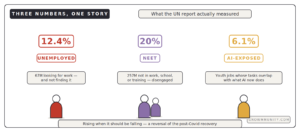
Youth unemployment rate (12.4%) counts people aged 15-24 who want a job, are actively looking, and can’t find one. Important context a beginner should know: youth unemployment is always roughly double the adult rate, everywhere, in every era. Young people are new to job hunting, lack track records, and are the easiest to not-hire. So 12.4% isn’t shocking because it’s high — it’s shocking because it’s rising, reversing the recovery that followed the pandemic.
NEET (20%) stands for Not in Employment, Education, or Training — and it’s arguably the more troubling number. An unemployed person is at least still knocking on doors. A NEET young person has, for whatever reason — discouragement, caregiving, exclusion — stopped engaging with the systems that build a future entirely. More than a quarter-billion people are in that category.
“Most exposed to AI” (6.1%) doesn’t mean those jobs vanish tomorrow. It means the tasks inside them overlap heavily with what AI can now do. Exposure is a measure of pressure, not a death sentence — we’ll come back to this.
The background: how did young workers end up here?
The report points to a convergence of forces, and regular readers will recognise every one of them from stories we’ve covered.
1. The world economy is growing too slowly to create enough jobs. Weak growth means cautious employers, and cautious employers stop hiring beginners first. We’ve watched this dynamic up close in China’s slowdown — and China is just the largest example of a global pattern.
2. Geopolitical tension is taxing growth. Trade wars, sanctions, and conflict — the subjects of our tariff and sanctions explainers — make businesses defer exactly the kind of expansion that generates entry-level openings.
3. The deterioration is broad. Between 2023 and 2025, youth unemployment rose in eight of the world’s eleven subregions. The regional table tells the story:
| Region | Youth unemployment | What stands out |
|---|---|---|
| Arab States | 26.2% | Highest in the world — more than 1 in 4 |
| Northern Africa | 22.6% | Second highest |
| Europe (N, S & W) | 15% | Weaker opportunities in 20 of 29 countries |
| North America | 9.8% | Lowest level — but the sharpest rise, up from 8.3% in 2023 |
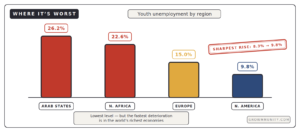
That last row is the report’s quiet bombshell: the frustration of blocked starts is now spreading fastest through wealthy economies — hitting, in the ILO’s words, the aspirations of millions at the very start of their working lives.
The disappearing middle: where the entry doors used to be
Here is the report’s most important structural insight, and it explains the mechanics better than any single statistic.
For generations, certain jobs served as the standard entrances to working life: clerical and administrative roles, sales positions, manufacturing work. They didn’t require elite credentials; they taught the unteachable basics — showing up, working with others, handling customers — and they paid you while you learned. Economists call them middle-skilled jobs. A beginner can think of them as the doors into the building.
Those doors are closing. The report highlights the sustained decline of exactly these occupations, and draws the conclusion plainly: a shrinkage of middle-skilled jobs means longer job queues and growing unemployment for young people with secondary education who seek them.
Picture a game of musical chairs — but the chairs being removed aren’t random. They’re specifically the beginner chairs. The experienced players barely notice; the new players circle a room with nowhere to sit. That’s the youth labour market of the mid-2020s: the overall unemployment rate can look calm while the entry level quietly empties out.

The AI question, handled honestly
Now the number everyone quotes: 6.1% of jobs held by young people (aged 15-29) are in the categories most exposed to AI, which the report warns could translate into millions more unemployed within a few years.
Notice the cruel geometry: the jobs AI handles best — routine clerical, administrative, entry-level office work — are largely the same doors that were already closing. AI doesn’t have to eliminate whole professions to hurt young workers; it just has to absorb the simple tasks that beginners used to be hired to do. The training ground and the endangered ground are the same ground.

Honesty also requires the other side, which we explored in The AI Boom and Your Job: exposure is not destiny. The ILO itself says technological change is transforming opportunities, not simply deleting them — new roles will exist, and AI skills increasingly command a premium. The genuine worry is narrower and sharper: the transition’s costs land first and heaviest on the people with the least experience to fall back on. A 45-year-old whose tasks get automated has a network and a track record. A 19-year-old has a locked door.
The American version: a frozen pond
The global report rhymes with what’s happening in the US labour market, which CNN’s reporting captures with the industry’s favourite phrase: “low-hire, low-fire.”
Translation: companies aren’t laying people off — but they aren’t hiring much either. Think of a frozen pond. Everyone already on the ice is perfectly safe; the surface is stable. But nobody new can get on. For insiders, the economy feels fine. For outsiders — above all the young — it feels shut.
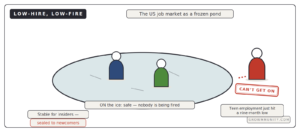
The data matches the metaphor: American teen employment recently touched a nine-month low, with young job hunters, in CNN’s words, missing out on the foundational roles and skills that working life is built on. A labour market can post a reassuring headline unemployment rate while quietly failing its newcomers — which is why economists have learned to read the youth numbers as an early-warning gauge for the whole system.
Why this matters even if you’re not 22
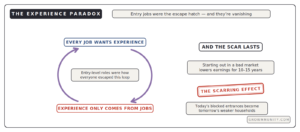
The scar is permanent-ish. Decades of research show that starting your career in a bad market lowers earnings for 10-15 years — the “scarring effect.” Today’s blocked entrances become tomorrow’s weaker households.
It’s everyone’s demand problem. A generation earning late and less buys homes late, spends less, and pays less tax — a slow leak in future growth. (257 million NEET young people is, among other things, an enormous amount of unused economic capacity.)
The experience paradox tightens. Every job wants experience; experience comes only from jobs. Middle-skilled roles were the historical solution to that riddle. Remove them without a replacement — apprenticeships, paid training, redesigned entry paths — and the paradox hardens into a wall.
Two honest views: crisis or transition?

The alarmed view: this is structural, not cyclical. Entry-level doors were already closing; AI accelerates the closure; and 257 million disengaged young people is a social and economic emergency in slow motion. Waiting for growth to fix it repeats the mistake of every prior jobs crisis — the young pay first and longest.
The adaptive view: labour markets have absorbed every previous technology wave — farm mechanisation, computers, the internet — each time destroying old entry paths and eventually building new ones. Youth unemployment is rising but remains far below crisis-era peaks, AI is creating demand for new skills, and the honest reading of “exposure” is change, not elimination. The task is managing a transition, not stopping a collapse.
Where both sides genuinely agree: the first rung is the whole game. Whether by market adaptation or deliberate policy — apprenticeships, hiring incentives, training that leads somewhere — economies that rebuild their entry points will be fine, and economies that don’t will pay for decades.
Difficult words, made simple
| Term | Plain-English meaning |
|---|---|
| Youth unemployment rate | Share of 15-24-year-olds who want work, are looking, and can’t find it — now 12.4% globally |
| NEET | Not in Employment, Education, or Training — disengaged entirely; 20% of the world’s youth |
| Middle-skilled jobs | Clerical, admin, sales, manufacturing — the traditional entry doors into working life |
| AI exposure | How much a job’s tasks overlap with what AI can do — pressure, not an automatic pink slip |
| Low-hire, low-fire | A frozen labour market: safe for insiders, sealed to newcomers |
| Scarring effect | Starting a career in a bad market drags earnings down for a decade or more |
| Experience paradox | Jobs require experience; experience requires a job — entry roles were the escape hatch |
| ILO | The UN’s International Labour Organization — publisher of the report |
| Employment-to-population ratio | Share of a group actually working — US teens just hit a nine-month low |
| Entry-level / first rung | The starter jobs that teach the basics — the part of the ladder now going missing |
The big takeaway
Strip the report to one sentence: the world is quietly removing the bottom rung of the career ladder — and AI threatens to take the next one too. Sixty-seven million young people are looking and not finding; a quarter of a billion have stopped looking altogether; and the sharpest deterioration is in the rich world, where “low-hire, low-fire” keeps insiders comfortable while newcomers circle a room with fewer and fewer chairs.
For a beginner, the transferable lessons are two. First, headline unemployment can hide a generational problem — always check who the average is averaging away. Second, technology’s costs are not distributed evenly across time-of-life: the same AI wave that boosts an experienced worker’s productivity can seal the entrance for someone with no experience at all.
Three things worth watching from here: the NEET number (the truest gauge of disengagement — if 20% keeps climbing, the crisis is compounding); youth unemployment in rich economies (North America’s jump from 8.3% to 9.8% is the trend to track); and whether entry paths get rebuilt — apprenticeships, paid training, AI-era starter roles. The ladder can be repaired. The report’s warning is simply that, right now, nobody is holding the toolbox.
New to economics? Start with What Is an Economy? — then read The AI Boom and Your Job and China’s Slowdown Explained for the forces feeding this story.
Sources
This article synthesizes reporting from Reuters (via Investing.com), RTTNews, and CNN:
• Reuters / Investing.com: Global youth unemployment rises amid sluggish job creation and looming AI risk, UN labour agency says
• RTTNews: Youth unemployment to worsen as jobs exposed to AI threat: report
• CNN Business: What the lull in teen hiring this summer tells us about the job market
All figures are drawn from those reports and the underlying ILO study, Global Employment Trends for Youth 2026. Background: International Labour Organization and NEET. This article presents both the alarmed and adaptive readings of the data without endorsing either. This is general information, not career or financial advice.
Growmmunity publishes explanations, not financial advice.