
Why Is My Electricity Bill So High? The AI Boom’s Invoice Is Landing in Your Mailbox
Why is my electricity bill so high? Millions of Americans have typed that exact question this year — and a growing part of the answer has nothing to do with your thermostat. You may never have used a chatbot in your life. You are, very possibly, paying for one anyway.
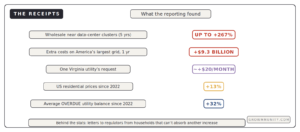
The numbers are startling. A Bloomberg analysis found that in areas near major data-center activity, wholesale electricity has cost as much as 267% more than five years ago. The average household’s total utility costs are running about $122 more per month than in 2020. And the strain is showing: the average overdue utility balance has jumped 32% since 2022, from $597 to $789.
Behind all of it sits the least glamorous side of the AI revolution: gigantic warehouses of hot computers, drinking electricity from the same shared grid your refrigerator uses. This guide explains what data centers are, exactly how their demand travels into your monthly bill, what’s genuinely AI’s fault versus everything else — and the fairness fight now brewing over who should pay. In plain English, as always. (New to economics? Start with What Is an Economy?)
First: what is a data center, and why does AI need so many?
Every AI answer, image, and video is computed somewhere physical. A data center is that somewhere: a warehouse packed with tens of thousands of specialised computers — the Nvidia chips from our $96 billion quarter story — running around the clock, plus industrial cooling to keep them from melting. If AI is a brain, data centers are the body, and the body is hungry.
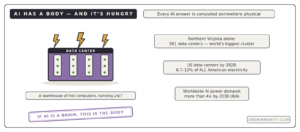
The scale has exploded. Tech giants are projected to spend hundreds of billions of dollars a year building these facilities; monthly US data-center construction spending recently hit a record $40 billion. Northern Virginia alone hosts 561 data centers — the biggest cluster on earth. The Department of Energy projects data centers could consume 6.7% to 12% of all US electricity by 2028, up from 4.4% in 2023, and the International Energy Agency expects worldwide AI data-center demand to more than quadruple by 2030.
Remember our AI Tokenomics explainer — every AI “token” costs computing power? This is where that abstraction becomes physical: computing power is electricity, and electricity comes from a grid you share.
How your bill actually gets made (the part nobody explains)
To see how a tech company’s server farm reaches your mailbox, you need two pieces of plumbing.
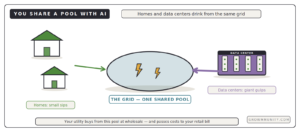
Piece 1: The shared pool. Electricity isn’t delivered like a private pizza; it’s drawn from a regional pool — a grid — that homes, shops, factories, and data centers all drink from together. Your utility buys power from this pool at wholesale prices, then sells it to you at retail, passing its costs along.
Piece 2: The auction. Wholesale power is priced through market auctions. When demand surges against limited supply, auction prices jump — and those jumps eventually flow into retail bills. This isn’t theoretical: after one record-setting capacity auction on America’s largest grid (PJM, serving 13 states from Illinois to Washington, DC), Baltimore households saw their average bill rise by more than $17 a month. The grid’s own market monitor calculates that data-center demand added over $9.3 billion in costs for consumers across that region in a single year.
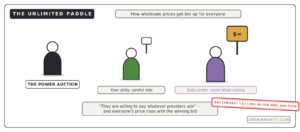
Now add the crucial detail about how data centers behave in those auctions. As Barclays economist Pooja Sriram explained to CNN: data centers demand huge amounts of power, crowd out electricity available for residents, and bid up wholesale prices — because they are willing to pay whatever providers ask — which ends up raising residential costs too.
Think of a quiet neighbourhood auction where one bidder shows up with unlimited budget. He isn’t bidding against you maliciously; he just never stops raising his paddle. Everyone’s prices rise anyway. That is the mechanism, and it’s why this is an economics story, not a villain story.
The receipts: what the reporting actually found
| Finding | The number |
|---|---|
| Wholesale power near data-center clusters vs 5 years ago (Bloomberg) | Up as much as 267% |
| Extra consumer costs on America’s largest grid in one year | $9.3 billion+ |
| Baltimore average bill after record power auction | +$17/month |
| One Virginia utility’s requested increase, citing data-center demand | ~$20/month over two years |
| US residential electricity prices since 2022 | +13% |
| Average overdue utility balance since 2022 | +32% ($597 → $789) |
| Projected winter heating cost this season | $1,205, up ~10% |
Behind the statistics are the letters regulators receive: an 81-year-old widow on a fixed income writing that she can’t afford the increase; a couple living paycheck to paycheck; a man asking why data centers shouldn’t pay their fair share. Those letters are why this issue has jumped from utility filings to front pages.
The honest nuance: how much of this is really AI?
A trustworthy explainer has to slow down here, because the full picture is messier than the angriest headlines.
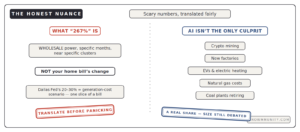
AI is not the only force pushing bills up. Bloomberg’s own reporting lists fellow culprits: crypto mining, new factories, the electrification of cars and home heating, rising natural-gas costs, and old coal plants retiring faster than replacements arrive. AI is the newest and fastest-growing pressure — not the only one.
The scary numbers need translation. That “267%” is wholesale power, in specific months, near specific clusters — not the change in anyone’s home bill. Likewise, Federal Reserve Bank of Dallas researchers estimate data centers could push electricity generation costs 20-30% higher by 2028 than they’d otherwise be — which does not mean your bill rises 20-30%; generation is only one slice of a retail bill.
And the industry disputes the framing. Amazon has pushed back directly on the claim that data centers raise residential bills, and grid operators note that untangling exactly how much of any increase belongs to AI versus everything else is genuinely hard. The direction of pressure is well documented; the precise size of AI’s share is honestly debated. A beginner should hold both facts at once.
The fight over who should pay
Here’s where this story is heading, and it’s a classic economics question wearing a tech costume: when one user strains a shared system, who pays for the upgrade?
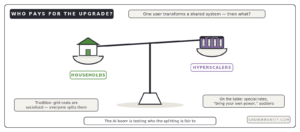
Grid costs have traditionally been socialized — spread across all users — because everyone benefited roughly alike. The AI boom breaks that logic: a handful of trillion-dollar companies now drive a huge share of new demand, while households and small businesses share the resulting bills. The policy responses being fought over include making data centers pay special, higher rates for grid upgrades; requiring them to “bring their own power” by funding new generation; and emergency auctions where tech giants would directly cover the surge costs. Politicians across the spectrum have started promising fixes — a sign that, as one Washington analyst put it, affordability remains the most potent issue in American politics.
Meanwhile the pressure connects to stories you’ve already read here: the same buildout is fuelling inflation pressure, and the same tech giants are borrowing so heavily for data centers that they’re competing with governments for bond buyers. The AI boom’s costs are arriving through every pipe at once.
Two honest views: growing pains or a rigged split?
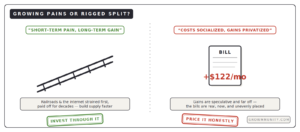
The “short-term pain, long-term gain” view: every transformative technology — railroads, electrification itself, the internet — strained infrastructure before delivering decades of growth. AI’s buildout is already creating jobs and construction wages, and if it delivers even part of its promised productivity, today’s grid investment will look cheap. On this view, the right response is building supply faster, not slowing the boom.
The “costs socialized, gains privatized” view: the productivity gains are speculative and far off; the bill increases are real and now — and they land on the people least able to absorb them, while the companies driving demand are the richest in history. Without rules making heavy users fund their own load, this is a quiet transfer from household budgets to shareholder returns. On this view, the fix isn’t stopping AI — it’s pricing it honestly.
Both sides actually agree on the physical fact: America needs vastly more power generation, fast. The fight is over who finances the gap — and your utility bill is where that fight is currently being settled by default.
Difficult words, made simple
| Term | Plain-English meaning |
|---|---|
| Data center | A warehouse of computers where AI actually runs — the physical body of the “cloud” |
| The grid | The shared regional pool of electricity that homes and data centers drink from together |
| Wholesale vs retail | What utilities pay for power vs what they charge you — costs flow from one to the other |
| Capacity auction | The market that prices future power supply — a record auction preceded Baltimore’s +$17/month |
| Crowding out | Big buyers absorbing supply and bidding up prices for everyone else |
| Rate case | A utility’s formal request to regulators to raise customer bills |
| Socialized costs | Grid expenses spread across all users — the tradition the AI boom is testing |
| Hyperscaler | A giant cloud company (Amazon, Microsoft, Google, Meta) building data centers at massive scale |
| Generation cost | The cost of producing power — one slice of your bill, not the whole thing |
| PJM | America’s largest grid operator, serving 13 states — ground zero for this story |
The big takeaway
The AI boom’s most universal effect so far isn’t a chatbot or a job change — it’s an invoice. Data centers drink from the same pool as your home, bid in the same auctions with effectively unlimited paddles, and share the same wires whose upgrades everyone splits. The result is documented pressure on bills across whole regions — layered on top of crypto, factories, EVs, and gas prices, which is why the honest answer to “how much is AI’s fault?” is: a real and growing share, whose exact size is still being argued.
For a beginner, keep three ideas. First, AI is physical — every token is electricity somewhere. Second, shared systems transmit costs — you don’t need to use a technology to pay for it. Third, the deep question underneath is ancient: who pays when one user transforms a common resource? Railroads, highways, and the internet all forced versions of that fight. Your utility bill is simply where this generation’s version is playing out.
Three things worth watching from here: your own utility’s rate cases (that’s where the numbers become personal); whether regulators force data centers onto special rates or “bring-your-own-power” deals (the fairness fight’s scoreboard); and the next PJM capacity auctions (the earliest signal of whether relief or another surge is coming). The AI era’s first bill has arrived. The argument now is over who picks it up.
New to economics? Start with What Is an Economy? — then read AI Tokenomics and the Nvidia story for the boom driving this bill, and Inflation Explained for where it all lands.
Sources
This article synthesizes reporting from CNN Business, Bloomberg, and CNBC:
• CNN Business: AI is making your life more expensive. Here’s how
• Bloomberg: AI Data Centers Are Sending Power Bills Soaring
• CNBC: AI data center ‘frenzy’ is pushing up your electric bill — here’s why
• CNN Business: Here’s how AI data centers affect the electrical grid
All figures are drawn from those reports and the sources cited within them, including PJM’s independent market monitor, the US Energy Information Administration, the Department of Energy, the International Energy Agency, the Federal Reserve Bank of Dallas, and the Century Foundation. Industry pushback, including Amazon’s, is noted in the reporting. This article presents both readings of the debate without endorsing either. This is general information, not financial advice.
Growmmunity publishes explanations, not financial advice.