
Why Are Bond Yields Rising Everywhere? The “Most Important Market on Earth,”
This week, financial records fell all over the planet — and most people never noticed, because they fell in a market that almost nobody watches.
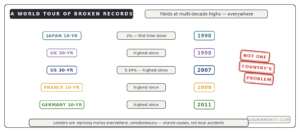
In Japan, the government’s 10-year borrowing rate crossed 3% for the first time since 1996. In the UK, the 30-year rate hit its highest since 1998. Germany touched levels unseen since 2011, France since 2008, and America’s 30-year Treasury recently reached 5.34% — its highest since 2007, before the global financial crisis. One strategist summed up what it all means: everything that touches credit in the major economies is about to get much more expensive.
As CNN put it in a line worth memorising: “The stock market gets most of the headlines, but the real power lies in the bond market.” This is the market that sets the price of your mortgage, decides whether governments can afford their debts, and — as one PBS report noted — is one of the few forces on earth strong enough to make politicians snap to attention. So why are bond yields rising everywhere at once? This guide explains what bonds and yields actually are, what’s driving the surge, and why it reaches your wallet — in plain English. (New to economics? Start with our foundation guide, What Is an Economy?)
First: what is a bond, and what on earth is a yield?
Start with the basics, because once you have them, every scary headline becomes readable.
A bond is an IOU. When governments and big companies need to borrow, they don’t walk into a bank. They sell IOUs to investors — “lend me $1,000 today, and I’ll pay you back with, say, 4% interest.” If you read our explainer on America’s $40 trillion debt, you’ve met these before: US government IOUs are called Treasuries, and they form the biggest, most-watched market on earth.
The yield is the return an investor actually earns — effectively, the interest rate. For a government, it’s the cost of borrowing money. That’s why rising yields worldwide can be summarised in five words: the price of money is rising.
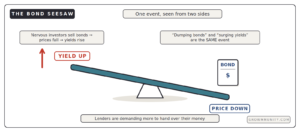
Now the part that confuses everyone, explained once and for all: bond prices and yields move in opposite directions, like a seesaw. Imagine you own an older IOU paying 4%. If nervous investors start dumping bonds and new ones must offer 5% to attract buyers, nobody wants your 4% IOU at full price — so its price falls until the discount makes the buyer’s effective return competitive. Selling pushes prices down; falling prices push yields up. So when you read “investors are dumping bonds and yields are surging,” that’s one event, not two: lenders are demanding more to hand over their money.
Why this quiet market is the boss of everything
Here’s why economists treat the bond market as the planet’s central nervous system.
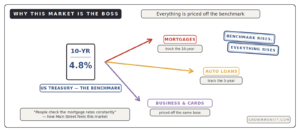
Because Treasuries are the biggest bond market, lenders everywhere use them as the benchmark for their own loans. Mortgage rates track the 10-year Treasury yield closely. Auto loans track the 5-year. Business borrowing, credit cards, other countries’ bonds — all priced off this one reference point. When the benchmark rises, everything built on it rises.
Heather Long, chief economist at Navy Federal Credit Union, described how ordinary people experience this: it’s scary for Main Street, and the way they see it — beyond the “$40 trillion debt” headlines — is that people check the mortgage rates constantly. The bond market is abstract; the monthly payment it produces is not.
And governments fear this market for the same reason. A rising yield means every new dollar of debt costs more to carry — which is why bond investors, when they sell in protest at bad policy, can force changes that voters and opposition parties can’t. The market doesn’t shout; it just quietly makes borrowing unaffordable until someone pays attention.
The background: three fires under one pot (plus a surprise fourth)
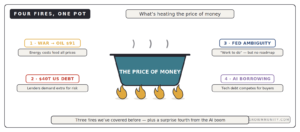
Why is this happening now, everywhere at once? The reporting points to four forces — and regular readers will recognise the first three as stories we’ve already covered, now converging.
Fire 1: The war is stoking inflation. The conflict with Iran has pushed oil back toward $91 a barrel — the chokepoint economics we explained in Why Oil Prices Are Rising. Energy costs feed into all prices, and bond investors hate inflation, because it eats the fixed payments bonds promise. Their defence: demand higher yields as compensation. Eurozone inflation just jumped to 3.3%, a three-year high — and markets now expect the European Central Bank to raise rates next week.
Fire 2: The debt mountain. America’s debt topped $40 trillion in August, with this year’s deficit alone near $2 trillion — about 6% of the economy, extraordinary outside recessions and wars. Investors are demanding greater compensation for the perceived risk of holding government debt — and the worry is global, from France’s budget fights to Japan’s decades of accumulated borrowing. (The full story: America’s National Debt Just Hit $40 Trillion.)
Fire 3: Central-bank uncertainty. The sell-off accelerated right after Fed Chair Kevin Warsh’s Jackson Hole speech — the “inflation is concerning… we have work to do” moment we covered in Is a Fed Rate Hike Coming?. Analysts at Capital Economics also point to unease about Warsh’s deliberate ambiguity: a Fed that won’t say what it will do leaves bond investors pricing in the worst.
The surprise fourth fire: AI. This one connects to our Nvidia story in a way few predicted. Tech giants are issuing enormous amounts of corporate debt to fund AI data centres — and those bonds compete with government bonds for the same investors. As one analyst put it: hyperscaler borrowing to fund AI infrastructure is competing for the same pool of buyers at the same moment governments need those buyers most. Less demand for Treasuries → lower prices → higher yields. The AI boom, it turns out, is quietly raising everyone’s borrowing costs.
The world tour of broken records
| Country | What happened | Last seen |
|---|---|---|
| Japan (10-year) | Crossed 3% — after decades of near-zero rates, inflation has returned | 1996 |
| UK (30-year) | Highest long-term borrowing cost in a generation | 1998 |
| United States (30-year) | Hit 5.34% — pre-financial-crisis territory | 2007 |
| France (10-year) | Budget worries push yields to multi-decade highs | 2008 |
| Germany (10-year) | Europe’s benchmark hits post-euro-crisis levels | 2011 |
 ds
ds
The pattern matters more than any single number: this is not one country’s problem. Lenders are repricing money everywhere, simultaneously — the signature of shared causes (energy, inflation, deficits) rather than local accidents.
The doom loop: why analysts keep using that phrase
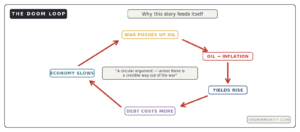
CNN’s reporting describes the risk as a potential doom loop, and the mechanics are worth understanding because they explain why this story feeds itself.
The war pushes up oil → oil pushes up inflation → inflation pushes up yields → higher yields make mortgages, business loans, and government debt itself more expensive → costlier debt worsens deficits and slows the economy → which spooks the bond market further. As market strategist Art Hogan put it: this becomes a circular argument unless and until there is a credible way out of the war. Or in the words of Fundstrat’s Hardika Singh: it feels like there is no end to the inflation problem, the war, or the deficit in the near term.
If that loop sounds familiar, it should — it’s the international, war-powered version of the debt spiral we drew in the national-debt explainer. Same feedback logic, bigger engine.
Why the stock market is sweating too
One more connection, and it answers a question beginners often ask: why do stocks fall when bond yields rise?
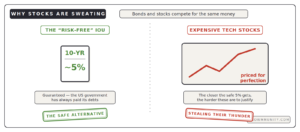
Because bonds and stocks compete for the same money. A US Treasury is traditionally considered the closest thing to a risk-free investment — the government has always paid. So as the 10-year yield climbs toward 5%, investors face a simple choice: a guaranteed ~5%, or expensive tech stocks priced for perfection? The closer that risk-free number gets to 5%, the harder the stocks are to justify. Higher yields, as CNN put it, are stealing thunder from stocks. (We watched this exact mechanism from the other side in Great Profits, But the Market Still Fell.)
Two honest views: warning light or siren?

The “warning, not crisis” view: LPL Financial’s Kristian Kerr states it plainly — the bond market is not signaling a crisis, but it is sending a warning that merits attention. Yields, while at multi-year highs, haven’t spiked at the pace a true panic would produce; PBS’s reporting notes the feared “tipping point” — a sudden stampede out of Treasuries — has not arrived. Governments retain tools (the US Treasury has already intervened with bond buybacks — the move that lit up the gold market), and part of the yield rise reflects something benign: surprisingly robust global growth.
The “doom loop” view: the three fires — war, inflation, deficits — have no near-term ending, and each feeds the others. Rates staying “higher for longer” grinds on mortgages, corporate borrowing, and government budgets simultaneously, while AI-era corporate debt keeps crowding the same buyers. On this reading, the records falling from Tokyo to Paris aren’t noise; they’re the sound of the world’s lenders losing patience at once.
Both camps watch the same scoreboard: the US 10-year yield’s march toward 5%, oil prices (the war’s transmission line), and whether any government produces a credible deficit plan. As one Evercore analyst noted, a real change in fiscal fundamentals would be a game-changer — which is another way of saying the fix is known, and the market is waiting to see if anyone does it.
Difficult words, made simple
| Term | Plain-English meaning |
|---|---|
| Bond | An IOU sold by a government or company — lend now, get repaid with interest |
| Yield | The return the lender earns — the price of money; for governments, the cost of borrowing |
| The seesaw | Bond prices and yields move oppositely: selling pushes prices down and yields up |
| Treasury | A US government bond — the world’s benchmark for pricing nearly all other loans |
| 10-year yield | The single most-watched number in finance — mortgages track it closely |
| Benchmark | The reference rate everything else is priced off |
| Deficit | One year’s government overspending — about $2 trillion in the US this year |
| Doom loop | War → inflation → higher yields → costlier debt → weaker economy → repeat |
| Risk-free rate | What Treasuries pay — the “safe” return stocks must beat to be worth the risk |
| Tipping point | The feared moment debt worry becomes panic selling — flagged, but not yet here |
The big takeaway
Strip away the jargon and this week’s story is one sentence: the world’s lenders are raising the price of money, everywhere, at the same time. War-driven oil costs, six years of stubborn inflation, $40 trillion of American debt, and even AI’s borrowing binge have converged on a single global market — and that market prices everything else: your mortgage, your country’s budget, and the stock valuations in your pension.
For a beginner, keep three ideas. First, bonds are just IOUs, and yields are just the price of money — nothing more exotic. Second, the seesaw: dumping bonds and surging yields are the same event, seen from two sides. Third, the line worth remembering whenever markets get loud: stocks get the headlines; bonds hold the power.
Three things worth watching from here: the US 10-year yield (the closer to 5%, the heavier everything gets); next week’s ECB meeting (a European rate hike would confirm the inflation regime has truly changed); and oil prices — because as long as the war keeps energy expensive, the first fire under this pot stays lit. The bond market isn’t shouting yet. But it has stopped whispering.
New to economics? Start with What Is an Economy? — then read America’s $40 Trillion Debt, the Jackson Hole explainer, and Why Oil Prices Are Rising — the three fires now burning under this one pot.
Sources
This article synthesizes reporting from CNN Business and PBS NewsHour (Associated Press):
• CNN: The war is raising the price of money. That’s a problem for the global economy
• CNN: The bond market rout is global. Here’s what’s driving it
• PBS NewsHour / AP: Why bond yields are rising and why everyone should care
All figures and quotes are drawn from those reports and the analysts cited within them, including Fundstrat, LPL Financial, Capital Economics, Evercore ISI, and Navy Federal Credit Union. Background: Bond market and US Treasury securities. This article presents both the reassuring and worried readings of the data without endorsing either. This is general information, not financial advice.
Growmmunity publishes explanations, not financial advice.
2 thoughts on “Why Are Bond Yields Rising Everywhere? The “Most Important Market on Earth,””