
China’s Record $119 Billion Trade Surplus: What a Trade Surplus Is — and Why the World Is Arguing
A trade surplus is what a country earns when it sells the world more than it buys from it — and in its latest monthly data, China reported the largest monthly trade surplus ever recorded: $119.1 billion in August alone, powered by exports that jumped a stunning 25% from a year earlier.
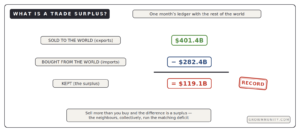
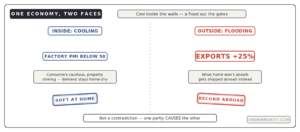
Here’s what makes the number genuinely strange: it comes from the same economy whose domestic side we described just days ago as stuck below the 50 line — factories shrinking, consumers cautious, property still sinking. Inside the walls, China looks tired. Through the export gates, it is shipping goods at a record pace: $401.4 billion out, $282.4 billion in, in a single month. Last year’s full-year surplus was already an all-time record near $1.2 trillion; this year is running ahead of it at $805 billion through August.
And the world has noticed. At recent G20 meetings, the US Treasury Secretary called China’s trade practices “the single largest barrier to global growth” — and, by one account, the room split roughly nineteen countries’ concerns against one. Beijing rejects the framing entirely. This guide explains what a trade surplus actually is, how one economy can be weak at home yet unstoppable abroad, and why a record surplus makes so many countries angry — in plain English, taking neither side. (New to economics? Start with What Is an Economy?)
First: what is a trade surplus?
Every country keeps a simple ledger with the rest of the world: exports (what it sells out) minus imports (what it buys in). Sell more than you buy, and the difference is a trade surplus. Buy more than you sell — America’s usual position — and it’s a trade deficit.
Picture a neighbourhood bakery. If the baker sells $400 of bread to the neighbours each month but only spends $280 at their shops, the baker runs a $120 surplus — and the neighbours, collectively, run the matching deficit. That’s August’s China, to scale: $401.4B sold, $282.4B bought, $119.1B kept.
One beginner’s trap to avoid immediately: a surplus is not automatically “winning,” and a deficit is not automatically “losing.” A surplus means the world wants your goods — but it can also mean your own people aren’t buying much, so everything gets shipped out instead. Hold that double meaning; it is the whole story here.
How can a “slowing” economy set export records?
This is the puzzle, and it has three honest pieces.
1. The two-speed economy. Remember the two thermometers from our China slowdown explainer — the weak official factory survey versus the stronger private one covering coastal exporters? This data is that split made vivid. Domestic demand is soft, so factories sell abroad what home won’t absorb. Weak-at-home and strong-abroad aren’t contradictions; one partly causes the other.
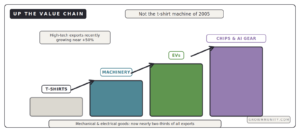
2. China moved up the value chain. This isn’t the cheap-t-shirt export machine of 2005. As one BNP Paribas economist put it, China has moved up the value chain and become a major player in AI infrastructure — the boom is in electric vehicles, machinery, semiconductors, and high-tech goods (high-tech exports were recently growing near 50% year-on-year; mechanical and electrical products are now nearly two-thirds of all exports). The world’s factories, data centers, and car lots are restocking from China even when its own consumers won’t spend.
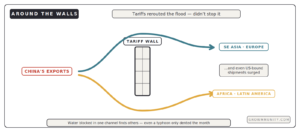
3. Tariff walls rerouted the flood — they didn’t stop it. Despite the trade war we covered in the tariff explainer, exports to the US actually surged by one measure — and shipments to Southeast Asia, Europe, Africa and Latin America grew fast as goods found new routes and new buyers. Water blocked in one channel finds others. (Even a typhoon that paused major ports in August only dented, not derailed, the month.)
Why a record surplus makes the world angry
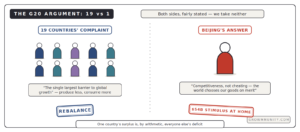
If exports are just successful selling, why the G20 confrontation? Because one country’s surplus is, by arithmetic, everyone else’s deficit — and the size now strains the system.
The complaint (as 19 countries voiced it): China produces far more than it consumes, and the overflow — priced aggressively, in every category from steel to EVs — lands on other countries’ industries. Competing factories in America, Europe, India, and Brazil face what they call an unabsorbable wave; the US Treasury Secretary’s “barrier to global growth” line is the sharpest official version. The demand behind it: rebalance — let Chinese households consume more, so China buys more of the world’s goods too.
Beijing’s answer: the surplus reflects competitiveness, not cheating — the world chooses Chinese EVs and machinery on price and quality, and blaming China is, in its commerce ministry’s words, an excuse for protectionism. And it notes it is stimulating: authorities just injected roughly $54 billion into major banks to spur domestic lending — an attempt to warm the home economy that, if it works, would shrink the surplus the natural way.
Notice this is the mirror image of stories we’ve covered: America argues about its deficits and debt; China gets attacked for its surplus. Both sides of the same ledger, each politically radioactive at record size.
Why it reaches you
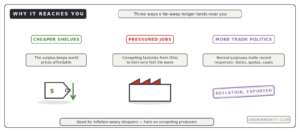
Cheaper goods, pressured jobs. The surplus is why so much on the world’s shelves stays affordable — and why manufacturing towns from Ohio to Germany feel squeezed. Both effects are real; which one you feel depends on whether you’re buying or competing.
More tariff politics ahead. Record surpluses invite record responses. Expect more duties, quotas, and “anti-dumping” cases — the sequel to our tariff series is effectively pre-written.
A deflation export. A flood of aggressively priced goods pushes world prices down — welcome news for inflation-weary shoppers, unwelcome for competing producers, and one more crosscurrent for central banks already struggling to read inflation.
Two honest views: engine or imbalance?
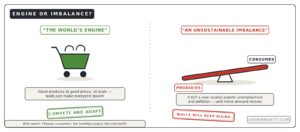
The “engine” view: the world is getting exactly what it’s paying for — good products at good prices, from EVs to solar panels, produced at a scale nobody can match. Punishing efficiency with walls makes everyone poorer; the fix for other countries is to compete and adapt, as they eventually did with every previous manufacturing champion.
The “imbalance” view: no system survives one participant permanently producing vastly more than it consumes; a $1-trillion-a-year surplus exports not just goods but unemployment and deflation to everyone else, and it persists precisely because Chinese households consume so little at home. Until that changes, walls will keep rising — and the trading system will keep fracturing.
Both sides agree on the scoreboard: Chinese domestic consumption (the $54B stimulus is aimed exactly there — if home demand revives, the surplus shrinks naturally), the monthly surplus itself, and the next round of tariffs.
Difficult words, made simple
| Term | Plain-English meaning |
|---|---|
| Trade surplus | Exports minus imports, when positive — August’s record: $119.1 billion |
| Trade deficit | The opposite — buying more than you sell; the world’s matching half |
| Exports / imports | Goods sold out ($401.4B) vs bought in ($282.4B) in one month |
| Value chain | The ladder from cheap goods to advanced ones — China climbed it: EVs, chips, machinery |
| Overcapacity | Producing more than home demand can absorb — the critics’ core charge |
| Rebalancing | Shifting an economy from exports toward home consumption — what 19 countries demand |
| Anti-dumping | Duties charged on goods allegedly sold below fair price — the usual counter-move |
| Stimulus | Government money to boost demand — like the ~$54B just pushed into banks |
| Rerouting | Trade finding new paths around tariff walls — Southeast Asia, Europe, Latin America |
| G20 | The forum of major economies where this week’s 19-vs-1 argument played out |
The big takeaway
China’s record month is one number wearing two faces. Read from outside, $119.1 billion is dominance: the world’s factory shipping EVs, chips, and machinery faster than ever, through tariff walls and typhoons alike. Read from inside, it’s a symptom: an economy whose own households buy so cautiously that production has nowhere to go but out.
Three ideas worth keeping. First, a trade surplus is arithmetic, not a trophy — exports minus imports, with a matching deficit somewhere else. Second, weak at home and strong abroad can be the same fact — soft domestic demand is part of what powers the export flood. Third, records this size are never just economics: when one ledger line hits $119 billion a month, it stops being a statistic and becomes geopolitics — which is why the argument that started at the G20 is only beginning.
New to economics? Start with What Is an Economy? — then read China’s Slowdown Explained for the domestic half of this story, and the tariff explainer for the walls the flood keeps finding ways around.
Sources
This article synthesizes reporting from NBC News (AP), Yahoo Finance (AP), and IBTimes Singapore:
• NBC News / AP: China’s exports jump 25% in August, pushing trade surplus to a record $119 billion
• Yahoo Finance / AP: China’s exports jump 25% in August as its global trade surplus balloons
• IBTimes Singapore: China’s August exports surge 25% with record $119 billion trade surplus
All figures are drawn from those reports and the customs data cited within them, including analysis from BNP Paribas. Officials’ statements on both sides are reported, not endorsed — this article takes no position in the trade dispute. This is general information, not financial advice.
Growmmunity publishes explanations, not financial advice.