
What Is the FOMC? Inside the Two-Day Meeting That Sets the Price of Money
What is the FOMC? It’s the twelve-person committee whose vote, announced at exactly 2:00 p.m. Eastern on the second day of its meetings, moves more money than any other scheduled event on Earth — repricing mortgages, credit cards, bonds, and stock markets within seconds. Its September gathering, on the 15th and 16th, is one of the four “big” meetings of the year, and it arrives with markets split roughly 55-60% on whether America’s interest rates go up.
Regular readers have watched every input arrive: Chair Warsh’s “we have work to do” warning, the +162,000 jobs shock, and the CPI report built to be the final exhibit. This guide explains the machine those inputs feed: who actually sits on the committee, what happens hour-by-hour across the two days, what the famous “dot plot” is, and how to read a Fed decision like a professional — in plain English. (New to economics? Start with What Is an Economy?)
First: who actually votes?
The Federal Open Market Committee is the Federal Reserve’s rate-setting body, and its structure is a deliberate balance of Washington and the regions. There are 12 votes: all 7 governors of the Federal Reserve Board in Washington, the president of the New York Fed (permanent vice chair of the committee, because New York executes the policies in the markets), and 4 votes that rotate annually among the other 11 regional Fed bank presidents — so Dallas, Chicago, San Francisco and the rest each get a regular turn.
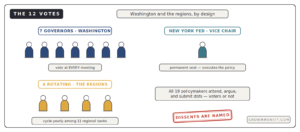
A detail beginners miss: all 19 policymakers attend and argue at every meeting, voters or not — and all 19 submit forecasts. The Chair leads the committee and faces the cameras afterward. Dissents are recorded by name, and they matter: split votes in recent years have been read as maps of the committee’s internal battle lines. (Contrast this with the ECB’s one-dial-for-twenty-countries design — the Fed’s version is one dial for fifty states, with the regions guaranteed seats at the table.)
The two days, hour by hour
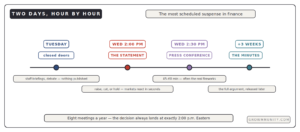
Day one (Tuesday): closed doors. Staff economists present the state of the economy; policymakers debate. Nothing is published — the suspense is structural.
Day two (Wednesday), 2:00 p.m. ET sharp: the policy statement drops — a few hundred words announcing whether the key rate rises, falls, or holds, plus carefully chosen language about the economy. Markets react within seconds, and professionals read it like forensic scientists: they compare it word by word against the previous statement, because a single changed phrase (“inflation remains elevated” gaining or losing a qualifier) can signal the next move.
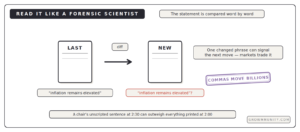
2:30 p.m.: the Chair’s press conference, typically 45-60 minutes of questions. This is often where the real fireworks happen — a chair’s unscripted sentence can move markets more than the decision itself, which is precisely the ambiguity game we covered at Jackson Hole.
Three weeks later: the minutes — a detailed account of the argument — get their own release date and can move markets all over again.
The dot plot: the Fed’s reluctant roadmap
Four meetings a year — March, June, September, and December — include the Summary of Economic Projections (SEP), which contains the chart traders universally call the dot plot: each of the 19 policymakers places an anonymous dot showing where they expect the key interest rate to sit at the end of the current year and the next few years, alongside forecasts for growth, unemployment, and inflation.
Why does a chart of anonymous dots move trillions? Because it’s the closest thing the Fed publishes to a roadmap. Markets fixate on the median dot — the committee’s middle expectation — and when it shifts (from “two cuts” to “one,” or toward a hike), bonds reprice immediately, exactly through the machinery in our bond-market explainer. The September meeting is a dot-plot meeting — which is why it carries more weight than a “small” one: markets get not just a decision but a full map of where 19 policymakers think rates go from here.
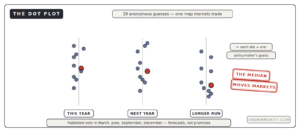
One honest caveat the pros repeat: dots are individual guesses, not promises. The committee itself has overridden its own dots many times when data changed. Read the map; don’t worship it.
Why this particular meeting is heavy
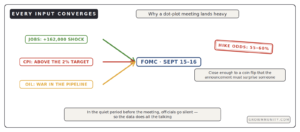
Every input we’ve tracked converges on it. The labour market printed a +162,000 shock against 53,000 expected — strength that gives the Fed room to act. Inflation remains above the 2% target with war-driven oil pushing energy through the pipeline. And the chair has spent weeks deliberately not ruling out a hike. Markets price the odds near 55-60% — close enough to a coin flip that the announcement is guaranteed to surprise roughly half the positioning either way.
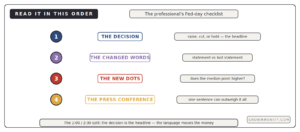
Whatever the vote, professionals will read four things in order: the decision itself; the statement’s changed words; the new dot plot (does the median now point higher?); and the press conference — where a single sentence about “the path forward” can outweigh everything printed before it. And one more part of the ritual worth knowing: in the roughly ten days before each meeting, Fed officials go silent — the quiet period — which is why the data (jobs, CPI) does all the talking in the run-up.
Two honest views: sacred institution or overwatched theater?
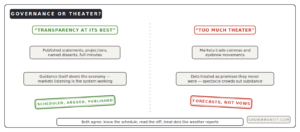
The “this is governance at its best” view: a transparent, scheduled, argument-driven process — published statements, projections, named dissents, full minutes — is exactly how unelected power should be exercised. The dot plot and pressers were transparency reforms; markets hanging on every word is the system working, since guidance itself steers the economy and reduces surprises.
The “too much theater” view: eight meetings, four dot plots, and hour-long pressers have turned monetary policy into a spectacle where markets trade commas and eyebrow movements. The dots get treated as promises they never were, single sentences trigger billion-dollar swings, and the obsession with Fed-watching crowds out attention to the real economy the Fed is supposed to serve.
Both agree on the practical takeaway: know the schedule, read the comparison, and treat the dots as weather forecasts — genuinely informative, frequently revised.
Difficult words, made simple
| Term | Plain-English meaning |
|---|---|
| FOMC | The Federal Open Market Committee — the Fed’s 12-vote rate-setting body |
| The statement | The 2:00 p.m. announcement — read word-by-word against the last one |
| Press conference | The Chair’s 2:30 Q&A — often moves markets more than the vote |
| SEP | Summary of Economic Projections — quarterly forecasts, home of the dot plot |
| Dot plot | 19 anonymous dots = each policymaker’s year-end rate guess |
| Median dot | The middle guess — the single number markets trade on |
| Dissent | A recorded “no” vote — a public map of the committee’s split |
| The minutes | The detailed account of the debate, released about three weeks later |
| Rotating seats | 4 of 12 votes cycle yearly among 11 regional Fed banks |
| Quiet period | The pre-meeting silence — why the data does the talking beforehand |
The big takeaway
The FOMC is the economy’s scheduled heartbeat: eight two-day meetings, one 2:00 p.m. sentence at a time. Learn its anatomy — 12 votes balancing Washington and the regions, a statement built for word-by-word comparison, a quarterly dot plot that maps 19 minds, a press conference where the real news often escapes — and every “Fed Day” headline turns from noise into information.
Three tools worth keeping. First, the 2:00/2:30 split: the decision is the headline, but the language moves the money. Second, the median dot is a forecast, not a vow — informative like a weather report, and revised like one. Third, remember what the whole apparatus is for: this committee sets the price that every other price of money — your mortgage, your card’s APR, your country’s debt bill — is built on.
New to economics? Start with What Is an Economy? — then read the Jackson Hole explainer, the Jobs Report guide, and What Is CPI? — the three inputs this meeting digests.
Sources
This article synthesizes explainers and schedule data from Finance Calendar, MacroOdds, and FedRateCalc, alongside the Federal Reserve’s official calendar:
• Finance Calendar: Next FOMC Meeting: September 16, 2026 — Full Schedule
• MacroOdds: 2026 FOMC Meeting Schedule: Every Date & What Happens
• FedRateCalc: September 2026 FOMC Meeting — Dates & Timeline
• Federal Reserve: FOMC Meeting Calendars and Information
Market-implied probabilities shift continuously and are cited as of publication. This article explains the institution’s mechanics and presents both perspectives on Fed-watching without endorsing either. This is general information, not financial advice.
Growmmunity publishes explanations, not financial advice.