
Housing and Economy: Why Property Shapes Your Money and the Whole Economy
Housing and the economy are deeply intertwined, because a home is at once the largest purchase most people ever make and one of the most powerful forces in the entire economy. Property shapes personal finances more than almost anything else, and the housing market can lift or sink whole economies. For most families, a home is their biggest expense and often their biggest asset. Understanding housing — as both a personal decision and an economic force — brings together many of the threads we have followed throughout this series, making it a fitting place to complete our journey.
Today, in our final article, we explore housing and the economy, and then step back to see the whole picture we have built together. We will explain why housing matters so much personally and economically, the rent-versus-buy question, how housing connects to the wider economy, and finally how everything in this series fits together. As always, we keep everything clear and practical.
Why housing matters so much
Housing holds a unique place in both personal finance and the broader economy because of its sheer scale and importance. For individuals, it is usually the largest financial commitment of a lifetime.
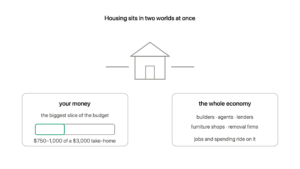
A home is where the biggest single chunk of most people’s money goes, whether through rent or through buying. A common rule of thumb is that housing swallows somewhere between a quarter and a third of take-home pay — so on the $3,000 monthly take-home we used in Budgeting Explained, that is $750 to $1,000 gone before anything else is decided. Because of this scale, housing decisions have an outsized effect on personal finances — on budgets, on savings, on debt through the mortgages we explored, and on long-term wealth. Few financial choices matter as much as those involving where and how you live.
For the economy as a whole, housing is equally significant. Building homes, buying and selling them, and everything connected to housing represents a large part of economic activity — construction workers, estate agents, surveyors, lenders, furniture shops, removal firms. When the housing market is strong, it supports jobs, spending, and growth; when it weakens, the effects ripple widely through all of them. Housing, in other words, is where personal finance and the national economy meet most powerfully.
The rent versus buy question
One of the most common and important housing decisions is whether to rent or to buy a home. This is a genuine trade-off, not a question with a single right answer, and understanding both sides helps you think it through for your own situation.
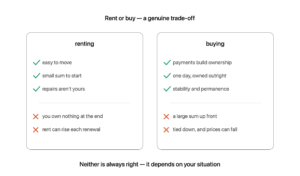
Renting offers flexibility and lower upfront cost. You can move more easily, you are not responsible for maintenance and repairs, and you do not need the large sum required to buy. The trade-off is that your rent payments build no ownership — you are paying for the use of someone else’s property, and at the end you own nothing.
Buying means that, over time, your payments build ownership of an asset that may grow in value, and eventually you may own the home outright. It can offer stability and a sense of permanence. But it requires a large initial sum, ties you to a location, brings the responsibilities and costs of ownership, and involves taking on a substantial mortgage. It also carries risk, since property values can fall as well as rise.
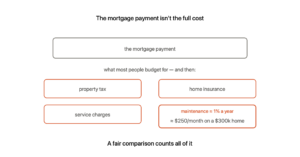
Here is a detail that catches many first-time buyers off guard: the mortgage payment is not the full cost of owning. On top of it come property taxes, home insurance, and maintenance — a common guideline sets aside roughly 1% of a home’s value each year for repairs, which on a $300,000 home is about $250 a month. Add service charges or fees where they apply, and the true monthly cost of owning can be considerably higher than the mortgage figure alone. A fair rent-versus-buy comparison has to include all of it.
Which is better depends entirely on your circumstances — your finances, your plans, your local market, and your preferences. One useful question is how long you expect to stay: buying carries large one-off costs at both ends, so the shorter the stay, the harder those costs are to justify. Recognizing it as a trade-off, rather than assuming one is always right, is the mark of thinking about it clearly. This mirrors a theme from across our whole series: economics is full of trade-offs, not perfect answers.
How housing connects to the wider economy
Housing is woven tightly into the broader economy we have explored, connected to interest rates, inflation, and the cycles of boom and bust. Seeing these connections shows how much of this series comes together in housing.
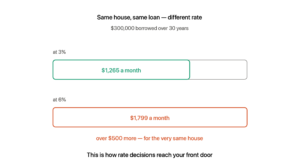
Housing is deeply tied to interest rates. Because most homes are bought with mortgages, and mortgage costs depend on interest rates, the decisions of central banks directly affect how affordable housing is. The effect is larger than most people expect. Take the same $300,000 loan over 30 years: at 3% the monthly payment is about $1,265, while at 6% it is about $1,799. The house has not changed, the buyer has not changed — but the monthly cost is over $500 higher. That is why rising rates cool the housing market and falling rates heat it up. The powerful lever we studied reaches directly into your rent or your mortgage.
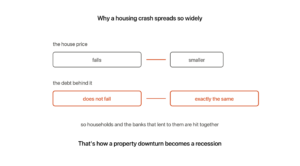
Housing is also connected to the bubbles and crashes we explored. Property has been at the center of some of history’s most dramatic bubbles, when home prices rose far beyond reason before collapsing. A housing crash hits harder than most because homes are usually bought with borrowed money: when prices fall, the debt does not fall with them, so households and the banks that lent to them are hurt at the same time. That combination is what turns a property downturn into a wider recession, as the events of past decades showed dramatically. Housing, then, is not just a personal matter but a force that can shape the entire economic cycle.
And underneath it all sits the most basic lesson of the series: supply and demand. Where homes are scarce and people want to live, prices climb; where building is plentiful or demand fades, they soften. Every housing headline you will ever read is, at bottom, a story about those two forces.
Thinking about housing wisely
Because housing decisions are so large and consequential, thinking about them wisely is especially important. The principles we have built throughout this series apply powerfully here.
Approach housing decisions within the context of your whole financial picture — your budget, your savings, your other goals — rather than in isolation. Understand the full cost of buying, including not just the mortgage but the many other costs of owning a home, so you are not caught off guard. Build your credit score before you borrow, since on a loan this size even a small difference in rate compounds into a very large number. Keep your emergency fund intact rather than draining it entirely for a deposit — a home with no cushion behind it is a fragile home. Recognize the rent-versus-buy decision as a genuine trade-off to weigh for your own situation, not a foregone conclusion.
Above all, avoid stretching yourself dangerously thin for housing, since a home that strains your finances can become a burden rather than a blessing. The wisdom we have cultivated — budgeting carefully, understanding debt and interest, respecting risk, thinking long-term — all applies directly to making sound housing decisions. Housing is where much of your financial knowledge comes together in one of life’s most important choices.
Bringing it all together: your complete economic picture
With housing, we complete our journey through the economy and personal finance. It is worth stepping back to see the remarkable picture we have built together, piece by piece.
We began with the foundations — money, inflation, and supply and demand. We explored the powerful world of interest rates and central banks, then markets and investing, and the cycles of booms, busts, and recessions. We widened our view to the global economy — trade, currencies, supply chains, emerging markets, and oil. We learned to read economic news and build our own economic worldview. And then we turned inward, to personal finance — budgeting, saving, credit, debt, loans, taxes, retirement, and housing — learning how to manage our own money within the economy we had come to understand.
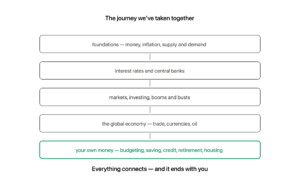
Throughout, the same great themes appeared again and again: everything is connected, there are always trade-offs, expectations matter as much as reality, and both the economy and wise financial habits reward patience and long-term thinking. These threads tie together everything from a central bank’s decisions to your own monthly budget, revealing the economy and your finances as parts of one connected whole.
Why this matters to you
Everything we have explored together matters because it touches every part of your life — your money, your work, your choices, your security, and your understanding of the world. You began, perhaps, feeling that economics and finance were intimidating, confusing, or beyond you. You end with a genuine, connected understanding of how the economy works and how to manage your own money wisely within it.
This knowledge is genuinely empowering and genuinely practical. You can now read the news with understanding, make financial decisions with confidence, avoid common and costly mistakes, and work steadily toward the life you want on a sound financial foundation. You understand the great forces shaping the world, and the personal habits that shape your own financial future. Few forms of knowledge are as useful across so much of life.
Most of all, you have gained something lasting: not a collection of facts to be forgotten, but a framework for understanding the economic world and your place in it for the rest of your life. The specific numbers and events will change, but the understanding you have built endures. You are now equipped to navigate the economy and your finances not with confusion or fear, but with knowledge, confidence, and clear eyes. That understanding is yours to keep and build upon — and it is one of the most valuable things you can carry with you through life. Thank you for taking this journey. The learning does not end here; it becomes the foundation for a lifetime of understanding.
Difficult words, made simple
| Term | Plain-English meaning |
|---|---|
| Asset | Something you own that has value, like a home |
| Rent | Paying to use a home you don’t own |
| Property value | What a home is worth, which can rise or fall |
| Housing market | The overall buying and selling of homes |
| Upfront cost | The large sum needed at the start to buy |
| Running costs | Ongoing costs of owning: tax, insurance, repairs |
| Trade-off | Gaining one benefit at the cost of another |
| Framework | A lasting way of understanding that outlives single facts |
The big takeaway
Housing sits where personal finance and the whole economy meet most powerfully — a home is usually the largest purchase of a lifetime and a major force in the economy. The rent-versus-buy decision is a genuine trade-off: renting offers flexibility and low upfront cost but builds no ownership, while buying builds an asset over time but requires a large sum, ties you down, carries risk, and brings running costs well beyond the mortgage payment.
Housing connects deeply to interest rates — the same $300,000 loan costs about $1,265 a month at 3% but $1,799 at 6% — and to the bubbles and crashes that can shake whole economies, because homes are bought with debt that does not shrink when prices do. With housing, our journey is complete. Together we have built an understanding stretching from money and inflation, through interest rates, markets, and the global economy, to the personal finance skills of budgeting, saving, credit, and retirement. The same themes tie it all together: everything is connected, trade-offs are everywhere, expectations matter, and patience is rewarded. What you hold now is a lasting framework for understanding the economy and managing your money — a genuinely empowering form of knowledge to carry through the rest of your life.
Explore the full series
This article completes our journey. To revisit any topic, explore the earlier articles across the whole series: the foundations of money, inflation, and supply and demand; interest rates and central banks; bonds, stocks, index funds, and compound interest; risk, bubbles, recessions, and the economic cycle; exchange rates, dollar dominance, trade, tariffs, supply chains, emerging markets, and oil; reading economic news and building an economic worldview; and the personal finance essentials of budgeting, saving and emergency funds, credit scores, credit cards and debt, loans and mortgages, taxes, retirement, and cryptocurrency. Each is a piece of the complete picture you now understand.
Sources
This article explains general principles of housing economics and personal housing decisions. Property markets, costs, taxes, and rules vary greatly by location, and all figures used are illustrative examples. It is general educational information, not financial advice.
Related reading: Loans and Mortgages Explained and Bubbles and Crashes.
Growmmunity publishes explanations, not financial advice.