
China Economy Slowdown Explained: Why the World’s Factory Keeps Shrinking
This morning, Beijing released one number — 49.8 — and economists around the world immediately understood what it meant. If you’re not one of them, that’s exactly what this guide is for.
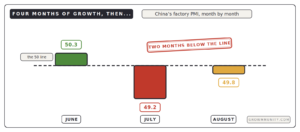
The number is China’s official manufacturing PMI for August, published today by the National Bureau of Statistics. It says that activity in the world’s biggest factory floor shrank for the second month in a row. Yes, 49.8 is better than July’s 49.2 — and it even beat forecasts — but it still sits below the line that separates growth from contraction.
Here’s why that one decimal matters far beyond China: China is the world’s largest exporter and its largest buyer of raw materials. When its factories cool, the chill travels — through commodity prices, shipping lanes, currencies, and eventually the price tags on things you buy. This guide explains what a PMI actually is, why China’s economy keeps sputtering, why two different surveys are telling two different stories, and what it all means for the rest of us — in plain English. (New to economics? Start with our foundation guide, What Is an Economy?)
First: what on earth is a PMI?
PMI stands for Purchasing Managers’ Index, and it is one of the most-watched numbers in all of economics — because it is fast, simple, and surprisingly honest.
Here’s how it works. Every month, statisticians ask purchasing managers at thousands of companies — the people who actually order the parts, materials, and supplies — a set of simple questions: compared with last month, did your output rise, fall, or stay the same? What about new orders? Hiring? Delivery times?
The answers get combined into a single index where 50 is the magic line:
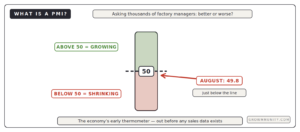
• Above 50 = more managers said “better than last month” — the sector is expanding
• Below 50 = more said “worse” — the sector is contracting
• Exactly 50 = no change
Think of it as taking the economy’s temperature by asking thousands of people on the factory floor how they feel — before any official sales or trade data exists. That’s why central banks from the Federal Reserve to the European Central Bank watch China’s PMI: it’s the earliest signal each month of how global demand is doing.
So today’s 49.8 translates to: “Slightly less bad than July. Still shrinking.”
The background: how did the world’s factory end up below 50?
China’s factories were actually growing for four straight months through June, when the PMI stood comfortably at 50.3. Then July delivered a shock — a 1.1-point plunge to 49.2, worse than every forecast, with weakness across firms of all sizes. August’s 49.8 is a partial recovery, not an escape.
Three forces explain the slump.
1. Chinese consumers aren’t spending enough. The polite term is “soft domestic demand.” The plain version: households and businesses inside China are being careful with money, so factories have fewer domestic orders. An economy can’t run at full speed when its own customers are sitting on their wallets.
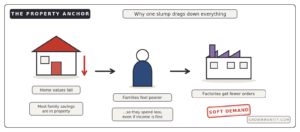
2. The property slump is the anchor. For decades, real estate was China’s growth engine — construction, steel, cement, appliances, and most importantly, household wealth. Most Chinese families hold the bulk of their savings in property. When home prices fall and developers struggle, families feel poorer, so they spend less — which loops right back into problem #1. The property contraction has been grinding on for years now and helped hold second-quarter GDP growth to a sluggish 4.3%, short of expectations. Think of it like a town where everyone’s house lost value at once: nothing else needs to go wrong for every shop in town to feel it.
3. Exports are a mixed bag. Some sectors — electric vehicles, solar panels — are booming overseas. But traditional manufacturing faces stiffer competition and geopolitical headwinds, from tariffs to sanctions frictions. We’ve covered both sides of that squeeze in the tariff wars and US sanctions policy — and China sits in the middle of nearly every one of those stories.
Inside today’s number: the good news and the bad news
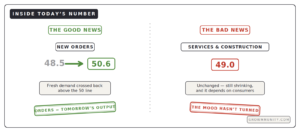
Headlines will say “contraction again,” but the details are genuinely more interesting — and more mixed.
The good news: the new orders sub-index — the best gauge of fresh demand — jumped from 48.5 to 50.6, back into growth territory. New export orders also crossed the line, rising to 50.1. Orders are tomorrow’s production, so this hints the worst of July’s slump may be easing.
The bad news: the non-manufacturing PMI — covering services and construction — came in at 49.0, unchanged and still contracting. That’s arguably the more worrying figure. Factories can be rescued by foreign buyers; services depend almost entirely on Chinese consumers feeling confident enough to spend. A services sector below 50 says they still don’t.
Put together: the factory floor is stabilising, but the mood of the Chinese consumer — the deeper problem — hasn’t turned.
Wait — a private survey says China is growing. Who’s right?
Here’s a wrinkle that confuses beginners, and understanding it will make you sharper than most casual readers.
Alongside the official government PMI, there’s a well-known private survey (the RatingDog/S&P Global PMI), and in July it read 50.9 — expansion! Same country, same month, opposite signal. Is someone lying?
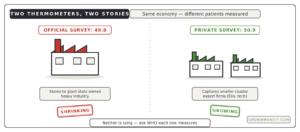
No — they’re pointing their thermometers at different patients. The official NBS survey skews toward large, state-owned enterprises — the giants of steel, energy, and heavy industry. The private survey captures more smaller, export-oriented firms along the coast. So the two surveys together actually tell one coherent story: nimble exporters selling EVs and electronics abroad are doing okay, while the big domestic-facing industrial economy — the part chained to property and local demand — is the part that’s shrinking.
The beginner’s lesson here is bigger than China: when two credible statistics disagree, ask who each one is measuring before asking which is “true.”
Why should you care what Chinese factories are doing?
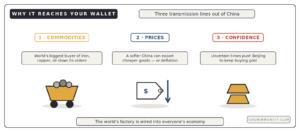
Because China’s economy is wired into yours, whether you notice or not. Three transmission lines:
1. Commodities. China is the world’s biggest buyer of iron ore, copper, oil, and other raw materials. When its factories slow, demand for those materials softens, and the economies that sell them feel it first — Australia’s currency, for instance, moves on Chinese PMI days precisely because China is its largest customer. (Currency ripple effects are exactly what our Exchange Rates explainer covers.)
2. The price of what you buy. A softer China can mean cheaper goods and weaker global inflation pressure — China exporting its slowdown as lower prices. That sounds nice until it tips into something economists genuinely fear: falling prices that feed on themselves. China has been flirting with exactly that problem, which is why our explainer Deflation: Why Falling Prices Can Be More Dangerous Than Rising Ones reads like a preview of this story.
3. The gold connection. Remember from our gold explainer that China’s central bank has been one of the world’s biggest gold buyers? A wobblier domestic economy and trade tensions are part of why Beijing keeps adding to those vaults — insurance-buying by a country navigating uncertain times.
What happens next: the stimulus question
Beijing has been signalling willingness to deploy additional stimulus — government spending, easier credit, consumer incentives — if the economy keeps stumbling. Whether that fixes things depends on which of two honest views you find more convincing.
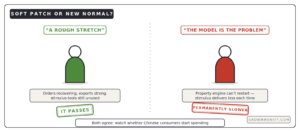
The “soft patch” view: August’s improvement is real. New orders are back above 50, exports in new industries are strong, and Beijing has plenty of stimulus tools it hasn’t fully used. On this reading, China is working through a rough stretch, and the direction of travel — 49.2 to 49.8 — is what matters.
The “structural slowdown” view: the problem isn’t a bad quarter; it’s the model. The property engine that powered decades of growth can’t be restarted, households won’t spend freely while their main asset deflates, and stimulus that worked in the past keeps delivering less. On this reading, sub-50 readings aren’t a phase — they’re a preview of a permanently slower China.
Serious economists hold each view. What both agree on: the number to watch isn’t really the factory PMI — it’s whether Chinese consumers start spending again. Until services cross back above 50, the recovery is borrowed, not built.
Difficult words, made simple
| Term | Plain-English meaning |
|---|---|
| PMI | A monthly survey asking factory managers if business got better or worse — the economy’s early thermometer |
| The 50 line | Above 50 = expanding, below 50 = contracting, exactly 50 = no change |
| Contraction | Activity shrinking compared with the month before — not necessarily a crisis, but the wrong direction |
| New orders sub-index | Fresh demand coming in — today’s orders are tomorrow’s production |
| Non-manufacturing PMI | The same survey for services and construction — currently the weaker half |
| Soft domestic demand | Chinese households and firms holding back on spending |
| Property slump | The multi-year downturn in Chinese real estate — the anchor dragging on everything else |
| Stimulus | Government spending, cheaper credit, or incentives designed to jump-start demand |
| NBS | China’s National Bureau of Statistics — publisher of the official PMI |
| Private PMI | An independent survey covering more small exporters — currently painting a rosier picture |
The big takeaway
One number, three lessons. First, China’s factory economy is still shrinking — less badly than July, with genuinely encouraging order flows, but shrinking. Second, the real story hides in the services number: until Chinese consumers feel confident enough to push that side above 50, every factory rebound rests on foreign demand. Third, the disagreement between the official and private surveys isn’t a scandal — it’s a map, showing an economy splitting into a thriving export-tech lane and a struggling domestic-property lane.
Three things worth watching from here: next month’s non-manufacturing PMI (the consumer-confidence tell), whether Beijing announces concrete stimulus (and whether markets believe it), and commodity prices (the fastest read on whether the world’s biggest raw-materials buyer is truly turning). The world’s factory isn’t closed — but it’s running below capacity, and the reasons run deeper than one month’s number.
New to economics? Start with What Is an Economy? — then read Deflation Explained and Exchange Rates to understand the forces this story runs on.
Sources
This article synthesizes reporting from the South China Morning Post, FXStreet, and investingLive:
• South China Morning Post: China’s factory activity stays in contraction in August despite improvement
• FXStreet: China’s NBS Manufacturing PMI climbs to 49.8 in August, Non-Manufacturing PMI steadies at 49.0
• investingLive: Economic calendar in Asia, 31 August 2026 — China official PMIs
All figures are drawn from those reports and the underlying data published by China’s National Bureau of Statistics. For more on how PMIs are built, see Purchasing Managers’ Index. This article presents both the optimistic and cautious readings of China’s data without endorsing either. This is general information, not financial advice.
Growmmunity publishes explanations, not financial advice.
1 thought on “China Economy Slowdown: Why the World’s Factory Keeps Shrinking”