
Jobs Report: How One Number Moved Every Market — and How to Read It Yourself
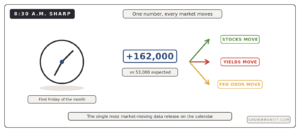
Jobs report explained in one scene: yesterday morning at exactly 8:30 a.m. Eastern, a US government agency published a single number — +162,000 — and within seconds, stock futures jumped, bond yields moved, and forecasts for the Federal Reserve’s next meeting were being rewritten. Economists had expected just 53,000 new jobs. The economy delivered three times that.
Here’s what makes this a perfect teaching moment: the same report is generating completely opposite headlines. Some read it as proof the economy has “fresh momentum.” Others point to the fine print — Americans quietly leaving the workforce, wage growth slowing, an entire industry shedding jobs — and see warning lights. And just two days earlier, a different jobs count said the month was the weakest since January. All of these readings are grounded in real data.
This guide teaches you the skill behind the headlines: what the monthly jobs report actually is, why it’s really two surveys wearing one name, why the “expected” number matters more than the actual one, and how to read Friday’s release like a professional — in plain English. (New to economics? Start with our foundation guide, What Is an Economy?)
First: what is “the jobs report”?
Officially, it’s the Employment Situation Summary, published by the US Bureau of Labor Statistics (BLS) — almost always on the first Friday of each month, at 8:30 a.m. sharp. It is widely considered the single most market-moving data release on the calendar, because jobs are where the economy becomes personal: paychecks drive spending, spending drives growth, and growth drives everything else.
Three headline numbers do most of the talking:
1. Nonfarm payrolls — how many jobs the economy added or lost. August: +162,000, a sharp rebound after early-summer weakness (including the July shock we covered in our youth unemployment explainer).
2. The unemployment rate — the share of job-seekers who can’t find work. August: 4.1%, unchanged.
3. Average hourly earnings — wage growth. August: +3.1% over the year, decelerating. Watched obsessively because fast wage growth can feed inflation.
The secret nobody tells beginners: it’s two surveys in a trench coat
Here’s the single most useful thing you can learn about this report: the payroll number and the unemployment rate come from two completely different surveys.
The establishment survey asks businesses: “How many people are on your payroll?” That produces the +162,000.
The household survey asks people in their homes: “Are you working? Are you looking?” That produces the 4.1% unemployment rate — and also the participation rate, the share of the population working or job-hunting at all.
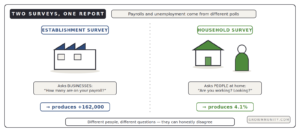
Because the two surveys ask different people different questions, they can genuinely disagree — one showing strength while the other softens. If that sounds familiar, it should: it’s the same lesson from our China explainer, where the official and private factory surveys told different stories. The rule travels everywhere: when two credible numbers disagree, ask who each one is measuring before asking which is “true.”
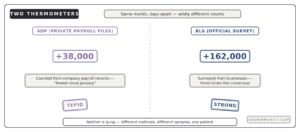
And August handed us a live example. Days before the official report, payroll processor ADP — which counts jobs from actual company payroll files — reported the private sector added just 38,000 jobs, the fewest since January. Then the BLS said 162,000. Different methods, different samples, different pictures, same month. Neither is lying; they’re different thermometers on the same patient.
Why “expected” matters more than the actual number
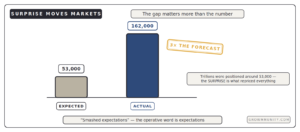
Notice what moved markets yesterday: not 162,000 itself, but the gap between 162,000 and the 53,000 economists expected. This is the concept regular readers have met twice now — with the Fed and with oil: markets trade on expectations, not events.
By release morning, trillions of dollars are already positioned around the consensus forecast. If reality matches it, little happens — the news was “priced in.” What moves prices is the surprise. A number three times the forecast is a genuine shock, which is why a single Friday morning can redraw the map for stocks, bonds, and the Fed all at once.
The beginner’s takeaway: when you see “jobs report smashes expectations,” the operative word is expectations. Always find the consensus number before deciding whether a report is strong or weak.
The fine print: how to read Friday’s report like a pro
Professionals never stop at the headline. Here’s the walk-through, using yesterday’s actual report.
The genuinely good: a 162,000 rebound after a weak summer; announced job cuts running at a four-year low; job openings edging higher. Employers are not firing — the “low-fire” half of the frozen labor market we described in the youth explainer is intact.
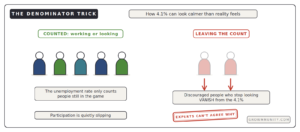
The caution flags: First, fewer Americans are working or looking for work — participation is slipping, and experts openly disagree about why. That matters because of a denominator trick: when discouraged people stop looking, they vanish from the unemployment rate, which can make 4.1% look calmer than reality feels. Second, wage growth decelerated to 3.1% — good for inflation, less good for paychecks. Third, the gains were uneven: restaurants and local schools hired, while the information industry — tech and media — lost jobs, consistent with the AI-era pressure on exactly those roles. Fourth, revisions: a preliminary benchmark update recently marked down earlier job growth, a reminder that each report is a first draft, corrected twice in later months as more payroll records arrive. Pros read the revisions to past months as carefully as the new number.
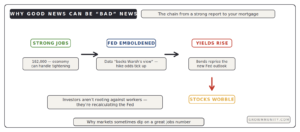
The counterintuitive part — good news can be “bad” news: a strong jobs report tells the Fed the economy can handle tighter policy. Analysts noted the data backs Chair Warsh’s view that the labor market is solid enough for the Fed to stay focused on inflation — which nudges rate-hike odds up, and pushes bond yields higher. That’s why stock markets sometimes wobble on great jobs numbers: investors aren’t rooting against workers; they’re recalculating the Fed.
Two honest views: solid bounce or surface strength?

The “solid rebound” view: 162,000 is a genuine bounce-back from June-July weakness, layoffs are historically low, openings are stable, and the unemployment rate has held at 4.1%. On this reading, the summer scare was a soft patch, and the labor market’s foundation — people keeping the jobs they have — remains firm.
The “look underneath” view: one strong month doesn’t erase the trend: participation is falling for reasons no one can agree on, wage growth is cooling, hiring is concentrated in a few sectors while tech sheds jobs, and revisions keep shaving earlier estimates. On this reading, the report describes a frozen-pond economy — comfortable for insiders, still sealed for newcomers — wearing one flattering month.
Both sides watch the same dials from here: the participation rate (are the missing workers coming back?), the revisions in next month’s release, and the Fed’s September decision, for which this report was the last major input.
Difficult words, made simple
| Term | Plain-English meaning |
|---|---|
| Nonfarm payrolls | Jobs added or lost, counted from business payrolls — August: +162,000 |
| Unemployment rate | Share of active job-seekers without work — 4.1%, from a survey of households |
| Establishment vs household survey | The two separate polls inside one report — businesses vs people — which can disagree |
| Consensus | Economists’ average forecast (53,000 this time) — the benchmark that defines “surprise” |
| Participation rate | Share of people working or looking — quietly slipping, and experts can’t agree why |
| Revisions | Corrections to past months as more data arrives — each report is a first draft |
| ADP report | A private jobs count from payroll files, released days earlier — a second thermometer |
| Average hourly earnings | Wage growth — 3.1% and slowing; the inflation-watcher’s favorite line |
| Low-hire, low-fire | Few layoffs, little hiring — safe for insiders, sealed for newcomers |
| Priced in | Already reflected in market prices — only surprises move markets |
The big takeaway
The jobs report isn’t a verdict; it’s a bundle of clues — two surveys, three headline numbers, a trail of revisions — and yesterday’s bundle contained real strength and real warning lights at the same time. That’s why honest people are writing opposite headlines about it, and why the skill worth having isn’t picking a side but knowing where each number comes from.
For a beginner, keep three tools. First, find the consensus before judging any report — surprise, not size, moves the world. Second, remember the two surveys — payrolls and the unemployment rate can honestly disagree. Third, watch the people who vanish — a falling participation rate can flatter the unemployment number while the frozen pond stays frozen.
Three things worth watching from here: the Fed’s September meeting (this report was its final major input — and its strength arguably strengthens the case for a hike); next month’s revisions to this very number (October 2, 8:30 a.m. sharp); and the participation rate — because the biggest question in the US labor market right now isn’t how many jobs were added, but where the missing workers went.
New to economics? Start with What Is an Economy? — then read the Jackson Hole explainer for why the Fed watches this report, and the youth unemployment story for who the headline numbers keep missing.
Sources
This article synthesizes reporting from CNBC, The Washington Post, and Axios, plus the primary data release:
• CNBC: Jobs report August 2026
• The Washington Post: The U.S. economy added 162,000 jobs in August, beating expectations
• Axios: August hiring was tepid as jobs report looms
• US Bureau of Labor Statistics: The Employment Situation — August 2026
All figures are drawn from those reports and analyses of the release, including the Economic Policy Institute’s breakdown. This article explains how to interpret the data and presents both readings without endorsing either. This is general information, not financial advice.
Growmmunity publishes explanations, not financial advice.
3 thoughts on “Jobs Report: How One Number Moved Every Market — and How to Read It Yourself”