
Yen Carry Trade Explained: Why Japan Finally Waking Up Is Shaking Global Markets
The yen carry trade explained in one sentence: for decades, the world has borrowed nearly-free money in Japan and invested it everywhere else — and in its latest data, Japan gave its clearest signal yet that the nearly-free era is ending.
The latest data from Tokyo was, in one strategist’s word, all-round strength: workers’ cash earnings jumped 4.7% — smashing the 3.8% forecast — with real wages (after inflation) up 2.4%, the biggest rise since May 2021 and the seventh straight monthly gain. Second-quarter GDP was revised up. Markets now put the odds of a Bank of Japan rate hike this month near 80% — one veteran analyst simply called it inevitable — and Japanese government bond yields are sitting at levels unseen in roughly 30 years.
Why should anyone outside Japan care? Because of that opening sentence. When the world’s cheapest lender starts charging, a global machine built on cheap yen — the carry trade — goes into reverse, and the tremors reach stock markets, currencies, and bond markets everywhere. This guide explains why Japan’s rates were near zero for a generation, what finally changed, how a carry trade actually works, and why its “unwind” rattles the planet — in plain English. (New to economics? Start with What Is an Economy?)
First: why were Japan’s interest rates near zero for decades?
Japan spent roughly thirty years fighting the opposite problem to everyone else. While the world battled inflation, Japan battled deflation — falling prices that made consumers delay purchases, companies freeze wages, and the whole economy idle. Our deflation explainer covers why that trap is so hard to escape; Japan was its textbook case.
The Bank of Japan’s answer was the loosest money in modern history: interest rates pinned at zero — at times below zero — for so long that an entire generation of Japanese borrowers never experienced a meaningful rate. The yen became the world’s discount money: reliably cheap to borrow, decade after decade.
What changed: the wage machine finally turned on
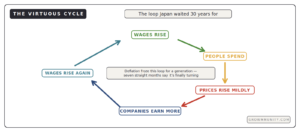
Central bankers escape a deflation trap only when a virtuous cycle starts: wages rise → people spend → prices rise moderately → companies earn more → wages rise again. Japan has waited a generation for that loop to catch. Today’s data is the strongest evidence yet that it has:
| The latest release | The number |
|---|---|
| Cash earnings (headline wages) | +4.7% vs 3.8% expected — “smashing” forecasts |
| Real wages (after inflation) | +2.4% — biggest since May 2021, 7th straight gain |
| Base pay | +4.1% |
| Q2 GDP (revised) | Upgraded to 1.4% annualized, from 1.1% |
| BOJ hike odds this month | ~80% — “now looks inevitable” |
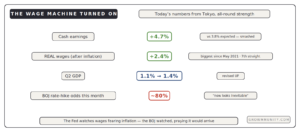
Notice the beautiful symmetry with stories we’ve covered: America’s Fed watches wages fearing inflation too high; Japan’s central bank watched wages praying inflation would finally arrive. Same dial, opposite prayers — and both now point toward higher rates. Markets, as always, trade the probabilities before the event: the 80% is the current market forecast, exactly the mechanism from our Jackson Hole explainer.
The main event: what is a carry trade?
Here’s the concept that makes Japan’s domestic story a global one — and it’s simpler than its reputation.
A carry trade is borrowing where money is cheap and investing where returns are higher, pocketing the gap. The recipe: borrow yen at ~0% → convert to dollars (or pesos, or euros) → buy something yielding 5% — Treasuries, tech stocks, emerging-market bonds → keep the ~5 point spread.
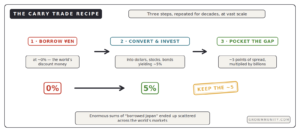
Multiply by decades of near-zero Japanese rates, and enormous sums of “borrowed Japan” ended up scattered across the world’s markets.
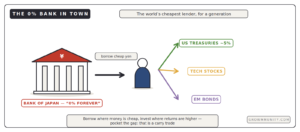
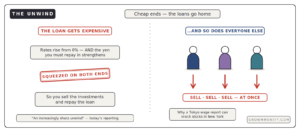
A homely analogy: imagine one bank in town offering loans at 0% forever. Naturally, people borrow there to fund everything everywhere else. Now that bank starts raising its rate — and the currency you must repay in starts strengthening. Suddenly your cheap loan is more expensive on both ends. What do you do? You sell the investments and repay the loan. So does everyone else who took the same trade. At once.
That mass exit is the carry trade unwind — and recent reporting flags exactly that: an increasingly sharp unwind of yen carry trades as a September hike turns certain. Unwinds are why a Tokyo wage report can knock stocks in New York: the selling isn’t about those assets’ merits; it’s borrowed money going home.
Why this ripples through everything (including stories we’ve covered)
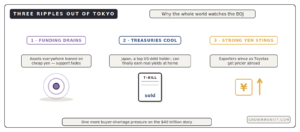
1. Global markets lose a funding source. Assets everywhere — from US tech stocks to emerging-market bonds — have quietly leaned on cheap yen. As the loans get repaid, that support drains away, and the crowded exits can turn small moves violent.
2. It piles onto the global bond story. Japan’s 10-year yield crossing multi-decade highs was one of the records in our bond-market explainer — and a rate hike reinforces it. Crucially, Japan is one of the largest foreign holders of US Treasuries: when Japanese investors can finally earn real yields at home, their appetite for American debt cools, adding one more buyer-shortage pressure to the $40 trillion story.
3. The yen strengthens — and Japan’s exporters wince. A rising yen makes Toyotas and machine tools pricier abroad, which is why Tokyo’s rate-sensitive stock index gets nervous even as workers celebrate. One country’s normalisation is simultaneously a raise for its households and a headwind for its exporters — a live reminder from our exchange-rates explainer that currencies always cut both ways.
Two honest views: healthy graduation or global margin call?
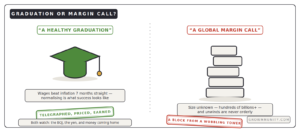
The “graduation” view: this is the good ending Japan waited thirty years for. Wages outrunning inflation for seven straight months is the virtuous cycle economists doubted would ever restart; normalising rates from emergency settings is what success looks like. The BOJ has telegraphed every step, markets have priced 80% odds, and a well-signposted hike is the opposite of a shock.
The “margin call” view: nobody knows the true size of the carry trade — estimates span hundreds of billions to over a trillion dollars — and history shows unwinds are never as orderly as planned; a sudden violent episode in recent memory wiped trillions off global equities in days. With world bond markets already strained and stocks priced for perfection, removing the world’s cheapest funding at this exact moment is pulling a block from a wobbling tower.
Both camps watch the same dials: the BOJ’s decision and language this month, the yen (sharp strengthening = unwind accelerating), and whether Japanese money starts coming home from US Treasuries.
Difficult words, made simple
| Term | Plain-English meaning |
|---|---|
| Carry trade | Borrow where money is cheap, invest where returns are higher, pocket the gap |
| The unwind | Everyone exiting that trade at once — selling assets to repay yen loans |
| BOJ | The Bank of Japan — keeper of the world’s cheapest money for a generation |
| Real wages | Pay after inflation — up 2.4%, the loudest “trap escaped” signal |
| Virtuous cycle | Wages → spending → mild inflation → profits → wages — the loop Japan waited decades for |
| Deflation trap | Falling prices that freeze an economy — Japan’s 30-year opponent |
| JGB | Japanese government bond — yields now at ~30-year highs |
| Normalisation | Moving rates off emergency settings — graduation, if it goes well |
| Funding currency | The money everyone borrows in — the yen’s global job description |
| Priced in | Already reflected in markets — the 80% odds trading before the decision |
The big takeaway
Japan’s story is two stories in one. At home, it’s a happy ending decades in the making: real wages rising seven months straight, growth revised up, an economy finally warm enough to justify real interest rates. Abroad, it’s a plumbing problem: the world borrowed vast sums of Japan’s cheap money, and cheap is ending.
Three ideas worth keeping. First, money flows toward gaps — the carry trade exists wherever rates differ, and it reverses when the gap narrows. Second, the world’s markets are wired together through funding, which is why a Tokyo wage report can shove New York stocks. Third, graduations can still be turbulent: the destination — a normal Japan — is good news; the journey runs through the biggest loan repayment in modern finance.
New to economics? Start with What Is an Economy? — then read Deflation Explained for the trap Japan just escaped, and Why Are Bond Yields Rising? for the global story this plugs into.
Sources
This article synthesizes reporting and analysis from investingLive, Investrade, and ADM Investor Services (ADMISI):
• investingLive: Asia calendar, 8 September 2026 — Japan GDP; BOJ hike bets near 80%
• Investrade: Morning Preview: September 08, 2026 — Japan GDP revised up, real wages +2.4%
• ADMISI (Marc Ostwald): The Day Ahead: 8 September 2026 — earnings smash forecasts; carry-trade unwind
All figures are drawn from those reports and the official releases cited within them. Background: Carry trade and Bank of Japan. This article presents both readings of the shift without endorsing either. This is general information, not financial advice.
Growmmunity publishes explanations, not financial advice.