
ECB Rate Hike Explained: Why Europe Is Raising Rates Into a Struggling Economy
An ECB rate hike is, in the words of one Aberdeen economist, “all but certain” — markets price the odds near 100% that the European Central Bank raises its key interest rate by a quarter point to 2.50% at its September 10 meeting. And the trigger is a number Europe hoped never to see again: eurozone inflation just jumped to 3.3%, its highest in almost three years.
Here’s what makes this a genuinely instructive story rather than just another rate headline. Europe’s inflation isn’t coming from a booming economy — growth only recently crawled back from a contraction, and businesses are already struggling. It’s coming almost entirely from one place: energy. With the Strait of Hormuz disrupted by the Middle East war, energy inflation has exploded to 14.3% — and Europe, a net importer of energy, has nowhere to hide. Meanwhile the “core” of inflation actually fell, to 2.4%.
So the ECB faces the classic central banker’s nightmare: raise rates to fight an inflation it didn’t cause and can’t directly fix, at the cost of squeezing indebted households and small businesses — or hold, and risk the fever spreading. This guide explains what the ECB is, why an energy importer suffers most from a faraway war, the crucial difference between a supply shock and a demand boom, and what a hike means for the world — in plain English. (New to economics? Start with What Is an Economy?)
First: what is the ECB?
The European Central Bank, headquartered in Frankfurt and led by President Christine Lagarde, is the Federal Reserve’s counterpart for the euro — except it sets one interest rate for 20 different countries sharing one currency. Germany’s factories, Italy’s debts, Spain’s tourism, France’s budget fights: one dial for all of them. Its mandate is the same 2% inflation target we’ve met before, and its main tool is the same: the price of borrowing money.
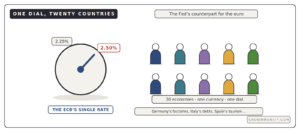
That “one dial, twenty economies” design is why every ECB decision is a compromise — and why this hike, from 2.25% to 2.50%, follows a cautious rhythm: a first hike in June (its first since 2023), a pause in July while it “monitored the intensity and duration of the energy shock,” and now, with inflation at 3.3%, a second step. Lagarde’s refrain: the ECB is “not pre-committing to a particular rate path” — meeting by meeting, data point by data point.
The background: how a strait closed and Europe’s prices jumped
Follow the chain, because it connects directly to stories we’ve covered.
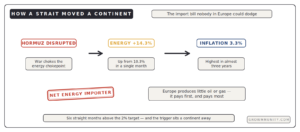
Step 1: The war closed the tap. The Middle East conflict and the disruption of the Strait of Hormuz — the chokepoint from our oil explainer — pushed global energy prices sharply higher.
Step 2: Europe pays first and most. Unlike the US, the eurozone produces little of its own oil and gas — it is a net importer. When energy gets expensive, Europe doesn’t just feel it at the pump; it ships money abroad to pay for every barrel. Energy inflation went from 10.3% to 14.3% in a single month.
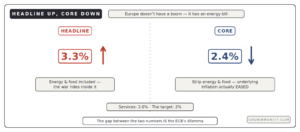
Step 3: Headline jumps, core falls. Overall inflation leapt from 2.9% to 3.3% — six straight months above target. But strip out energy and food (the “core” concept from our CPI explainer) and underlying inflation actually eased to 2.4%, with services at 3.0%. Translation: Europe doesn’t have an overheating economy. It has an energy bill.
The key idea: a supply shock is a different disease
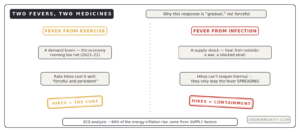
The ECB’s own economists published an analysis making exactly this point, and it’s the most valuable lesson in this story. They found that around 90% of the rise in energy inflation came from supply factors — the war choking off energy — and explicitly contrasted it with the 2021-22 inflation surge, which mixed supply problems with red-hot demand and stimulus. Their conclusion: “These differences are key to explaining why monetary policy responses differ.” This time, the response is deliberately “gradual” — quarter-point steps — where 2021-22 brought hikes that were “forceful and persistent.”
A body analogy makes the distinction click. A demand boom is a fever from over-exercise: the economy is running too hot, and rate hikes — making borrowing expensive — cool it effectively. A supply shock is a fever from infection: the heat comes from outside (a war, a blocked strait), and rate hikes can’t reopen Hormuz. What they can do is prevent the fever from spreading — stopping businesses and workers from building 3-4% inflation into every price and wage for years. That containment job, not curing the war, is what the ECB is buying with this hike. It’s the same dilemma the Fed faces with oil-driven prices, which regular readers saw in the Jackson Hole explainer — and it’s why both sides of the Atlantic sound so conflicted at once.
Why the world is watching (and what it costs Europe)
The painful part: higher rates land on economies already limping. Eurozone growth only recently rebounded (+0.6% in the second quarter after a -0.2% contraction), and economists warn the hike is a second blow to heavily indebted households and struggling small businesses — paying more for energy and more for credit simultaneously.
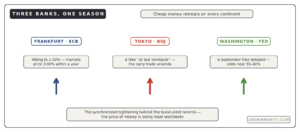
The global part: this makes three major central banks leaning the same direction in the same season — the Fed weighing a hike, the Bank of Japan’s hike looking “inevitable”, and now the ECB moving. The era of cheap money is retreating on every continent at once, which is exactly the pressure driving the global bond-yield records — German and French borrowing costs at multi-decade highs were part of that world tour. Analysts at BBH note markets already price ECB rates reaching 3.00% within twelve months — the top of the bank’s estimated “neutral” range.
Two honest views: necessary discipline or punishing the victim?
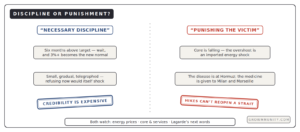
The “hike” case: six consecutive months above target is how expectations come unanchored; wait, and 3%+ inflation becomes the new normal that takes years and real pain to reverse. The move is small, gradual, fully telegraphed, and — with markets pricing it at ~100% — refusing now would itself be a shock. Credibility, once spent, is the most expensive thing a central bank can buy back.
The “hold” case: core inflation is falling and nearly at target; the entire overshoot is an imported energy shock that rate hikes cannot touch. Raising borrowing costs on indebted households and fragile firms to fight a war-driven oil price punishes the victims of the shock without addressing its cause — and risks tipping a barely-growing economy back into contraction. The disease is at Hormuz; the medicine is being given to Milan and Marseille.
Both camps agree on the scoreboard: energy prices (the war’s transmission line), core and services inflation (proof of whether the fever is spreading), and Lagarde’s language — whether this is a one-off containment step or, as one economist framed the real question, the start of “a protracted tightening cycle.”
Difficult words, made simple
| Term | Plain-English meaning |
|---|---|
| ECB | The European Central Bank — one interest-rate dial for 20 euro countries |
| Rate hike | Raising the price of borrowing — here, 2.25% → 2.50% |
| Eurozone | The 20 countries sharing the euro |
| Net energy importer | Buys more energy than it produces — why Europe pays first when oil jumps |
| Headline vs core | All prices (3.3%) vs prices minus energy & food (2.4%) — the gap IS the story |
| Supply shock | Inflation from outside — a war, a blocked strait — that rate hikes can’t cure |
| Second-round effects | The fever spreading — energy costs leaking into wages and all prices |
| Neutral range | Rates that neither stimulate nor brake — estimated 1.75%-3.00% for the ECB |
| Gradual normalisation | Quarter-point steps, meeting by meeting — this cycle’s deliberate pace |
| Anchored expectations | Everyone believing inflation returns to 2% — the thing the hike defends |
The big takeaway
Europe’s rate hike is a masterclass in the hardest problem in central banking: imported inflation. A war a continent away closed a strait, an energy-importing economy’s prices jumped to 3.3%, and its central bank must now choose between tolerating the overshoot and squeezing an economy that did nothing to cause it. The ECB’s answer — small, gradual, telegraphed steps aimed at containment rather than cure — is itself the lesson.
Three ideas worth keeping. First, geography is monetary destiny: the same oil price hits an energy importer far harder than a producer. Second, diagnose before dosing — supply shocks and demand booms are different diseases, and the ECB’s own economists built the case that this one is 90% supply. Third, the pattern is now global: Frankfurt, Tokyo, and Washington are all tightening in the same season — and the price of money worldwide is being reset accordingly.
New to economics? Start with What Is an Economy? — then read Why Oil Prices Are Rising for the shock’s source, What Is CPI? for headline-vs-core, and Why Are Bond Yields Rising? for the global picture this plugs into.
Sources
This article synthesizes reporting from CNBC, Euronews, and Bloomberg:
• CNBC: Euro zone inflation is back above 3%. Higher interest rates are likely to follow
• Euronews: ECB rate hike looms as energy shock pushes inflation to 3.3%
• Bloomberg: Euro-Zone Inflation Jumps to Highest in Almost Three Years
• CNBC: An ECB rate hike is ‘all but certain’ — but investors divided on what comes next
All figures are drawn from those reports, Eurostat data, and the ECB analysis cited within them. This article presents both policy views without endorsing either. This is general information, not financial advice.
Growmmunity publishes explanations, not financial advice.